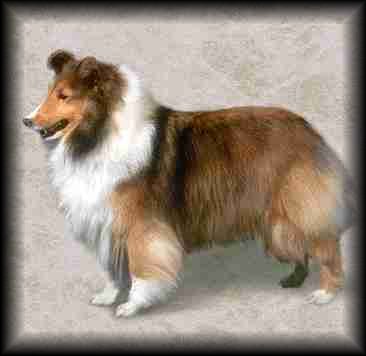
The Shetland Sheepdog, as its name implies, is a working Collie in miniature. There is little doubt that the small working Collie, from which came the modern show Collie evolving on larger lines, was likewise the progenitor of the Shetland Sheepdog evolving on smaller ones. It was assisted in the process by the environment of the Islands, which produced diminutiveness in all its stock, and by crosses with other breeds residing in, if not indigenous to, the Islands.
The Shetland Islands themselves are not conducive to abundance of fodder or flock, made up as they are of rugged rocks on which only meager vegetation can survive and surrounded by the sea, which brews frequent and severe storms. Small wonder that only the hardiest of both man and beast, and the smaller, could find subsistence. The actual origin of the breed cannot be traced by reference to records, as none were ever written. Tradition makes the dogs as old as the working Collies of Scotland, which frequently came to Shetland as the breed's forebears, and as old as the Islands themselves.
As the Islands were isolated from the trend of travel, the little dogs were a long time coming to the ken of dog-loving folk. Thus the breed did not take its place on the show bench until well along in the present century. The year 1909 marked the initial recognition of the Sheltie by the English Kennel Club. Not until 1914 did the breed obtain separate classification as Shetland Sheepdogs, and not Shetland Collies, because of pressure brought to bear by the Collie breeders. The first Challenge Certificate was awarded to the breed in 1915, after which World War I put a stop to all progress for the next few years.
The first Shetland Sheepdog registered by the American Kennel Club (1911) was Lord Scott, a golden brindle imported from Shetland by John G. Sherman, Jr. of New York. The American Shetland Sheepdog Association, parent club of the breed, was organized at the Westminster Kennel Club show in 1929, and held its first specialty in 1933.
The history of the several clubs catering to the breed reflects the struggle of breeders to fix and perpetuate the proper type and size. The Shetland Sheepdog Club in the Islands, founded in 1908, was, of course, the oldest. They asked for a rough Collie in miniature, height not exceeding 15 inches. The Scottish Shetland Sheepdog Club, a year later, asked for first an "ordinary Collie in miniature" and finally a "modern show Collie in miniature," ideal height 12 inches, and eventually 13 1/2. The English Shetland Sheepdog Club, founded in 1914, was an offshoot of the Scottish requiring "approximately a show Collie in miniature," height (ideal) first 12 inches and finally from 12 to 15, the ideal being 13 1/2. The British Breeders' Association came into being for a time as the offspring of the English Club and asked for a "show Collie in miniature," maintaining the same heights. In 1930 the Scottish and English Clubs revised their standards jointly to read "should resemble a Collie (Rough) in miniature." The American Shetland Sheepdog Association, youngest in years, tried to profit by the experience of its predecessors by combining the best of each in its standard.
On the subject of size, the current American standard specifies that the Shetland Sheepdog should stand between 13 and 16 inches at the shoulder. Importantly, it calls for disqualification for heights above or below this range.
The breed characteristics common to all Shelties can be used for two purposes pertaining to their working propensities or their companionship qualities. It is their nature to obey, willingly and naturally, with few or no lessons needed, an instinct coming no doubt from the many generations of obediently trained dogs behind them. This responsiveness has helped to make them one of the most successful of all breeds in Obedience trial competition. The instinct to guard property or places and to give watchdog warning makes them invaluable for work as farm helpers or home protectors, a heritage of the constant vigilance required to protect the crofters' cottages, flocks, and herds from invaders of all kinds. Their ability to run swiftly and gracefully, and jump with agility over obstacles, makes them a delight in fields and woods as well as in farm work. But what most endears them to everybody is their devoted, docile natures and their keen and all but human intelligence and understanding.