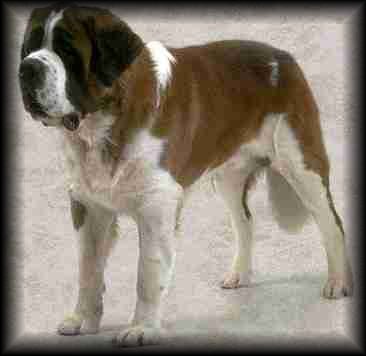
Shrouded in legend and the mists of time, the origin of the Saint Bernard is subject to many theories.
It seems most probable that the Saint Bernard developed from stock that resulted from the breeding of heavy Asian "Molosser" (Canis molossus ), brought to Helvetia (Switzerland) by Roman armies during the first two centuries A.D., with native dogs which undoubtedly existed in the region at the time of the Roman invasions.
During the following centuries, these dogs were widely used in the valley farms and Alpine dairies for a variety of guarding, herding, and drafting duties. Referred to as Talhund (Valley Dog) or Bauernhund (Farm Dog), they were apparently well established by A.D. 1050, when Archdeacon Bernard de Menthon founded the famous Hospice in the Swiss Alps as a refuge for travelers crossing the treacherous passes between Switzerland and Italy.
Just when dogs were first brought to the Hospice is debatable, since the Hospice was destroyed by fire in the late 16th century, and, soon after, a large part of the Hospice archives were lost. The first notation concerning the dogs was not until 1707. This, however, was merely a casual reference to dogs at the Hospice and carried the implication that their rescue work at the St. Bernard Pass was a fact well known at the time. From a digest of early references, it appears that the dogs were first brought to the Hospice sometime between 1660 and 1670. It is likely that large dogs were recruited from the valley areas below to serve as watchdogs for the Hospice and companions for the Monks during the long winter months when the Hospice was almost completely isolated.
This isolation of the Hospice no doubt resulted in inbreeding of the original stock which soon produced the distinctive strain of "Hospice Dog." It also follows that only those animals with the strongest instincts for survival in the extremely adverse conditions at the Hospice were to leave their genetic imprint upon the breed during those early years.
The lonely Monks, who took the dogs along on their trips of mercy, soon discovered the animals were excellent pathfinders in the drifting snow, and the dogs' highly developed sense of smell made them invaluable in locating helpless persons overcome during storms. Thus began this working together of Monk and dog which made many of the world's most romantic pages of canine history.
During the three centuries that Saint Bernards have been used in rescue work at the Hospice, it is estimated that they have been responsible for the saving of well over 2,000 human lives. Although the building of railroad tunnels through the Alps has lessened foot and vehicular travel across the St. Bernard Pass, the Monks have continued to maintain these fine dogs for companionship and in the honor of the Hospice tradition.
We are told that Saint Bernards required no training for their work since generations of service in this capacity seemed to have stamped the rescuing instinct indelibly upon their character. It would be more accurate to say that the dogs' rescue instincts were used as the basis for training by the Monks. In the company of the Monks, young dogs were taken on patrols with a pack of older dogs in search of possible traveler casualties. When the dogs came upon a victim, they would lie down beside him to provide warmth for their bodies, and lick the person's face to restore consciousness. In the meantime, one of the patrol dogs would be on his way back to the Hospice to give the alarm and guide a rescue party to the scene.
In addition to their pathfinding capabilities and keen sense of smell which enables them to locate human beings buried under the snow, the dogs are reputed to possess an uncanny sixth sense which warns them of approaching avalanches. Instances have been reported where a dog would suddenly change position for no apparent reason a few seconds before an avalanche came hurtling down across the spot where he had stood, burying it under tons of snow and ice.
Although it was well known that a special type of dog did rescue work at the Hospice by 1800, the breed at that time had been given no name other than "Hospice Dogs." Between 1800 and 1810, Barry, perhaps the most celebrated dog in history, lived at the Hospice. For fully half a century after his death, the Hospice dogs in certain parts of Switzerland were called "Barryhund" (Barry dog) in his honor.
Barry is credited with saving forty lives. Although legend has it that he was killed by the forty-first person he attempted to rescue, who mistook his bulk for that of a wolf, this tale is only an interesting story. As a matter of fact, Barry was given a painless death in Bern, Switzerland, in 1814, after he had attained a ripe old age. His likeness in mounted form is now preserved in the Natural History Museum in Bern.
The years 1816 to 1818 were seasons of uncommonly severe weather at the Hospice, and, as a result, many of the leading Hospice strains perished. It was easy at that time, however, to get good animals of like breeding from the lower valleys, and within a few years, the dog situation at the Hospice was again satisfactory. Confronted by a similar situation in 1830, coupled with the fact that their breed was considerably weakened by inbreeding and disease, the Monks resorted to an outcross to give added size and new vigor to their dogs. The Newfoundland, which at that time was larger than the Saint Bernard and shared strong rescuing instincts, was the breed decided upon to give the new blood. Results of this cross showed all of the desired objectives and, at the same time, did not destroy the Saint Bernard type and characteristics. Due to this crossing, however, the first longhaired Saint Bernards appeared--prior to 1830 all the Saint Bernards were shorthaired dogs.
At first it was believed that the longhaired variety might have an advantage in the snow and icy conditions existing at the Hospice. Unfortunately, ice clung to the coat and made the longhaired dogs unsuited to the tasks of the rescue dogs. After this was determined, the Monks gave the longhaired dogs as gifts to friends and benefactors in the valley areas, and only the shorthaired dogs were kept at the Hospice.
The English, who as early as 1810, imported some of the Hospice dogs to replenish their Mastiff blood, referred to the breed for a number of years as "Sacred Dogs." In Germany, around 1828, the name of "Alpendog" was proposed. In 1833, a writer, Daniel Wilson, first spoke of the so-called Saint Bernard dog, but it was not until 1865 that this name definitely appeared, and only since 1880 has it been recognized as the official designation for the breed.
During the last half of the 1800s, breeding of both the longhaired and shorthaired Saint Bernards continued in the valleys of Switzerland, and eventually the breed spread across Germany and other continental European countries and England.
In 1887, an International Congress was held in Zurich which was guided by Swiss authorities on the breed. At this Congress, an International Standard for the perfection of the breed was developed.
The Saint Bernard Club of America was organized in 1888, the year following the Zurich Congress, and the International Standard was adopted by it. This club continues to function for the interests of the Saint Bernard and is one of the oldest specialty clubs in the United States.