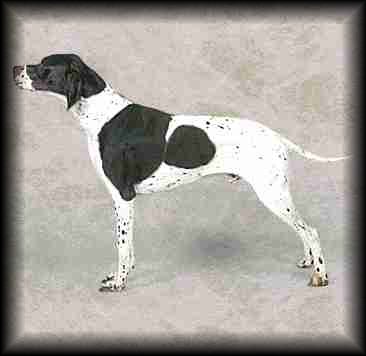
The Pointer comes by his name honestly. He was the first dog, so far as we know, used to stand game in the sense in which we use the term today, and was developed as a distinct breed much earlier than any of the setters. For years it was believed the first Pointers used in England were importations from Spain and Portugal, but that theory has been pretty thoroughly disproved and it seems far more likely that Pointers came into general use in Spain, Portugal, throughout eastern Europe and in the British Isles at approximately the same time. Whether or not the dogs from which they sprung were native to all these places no one can say, but it can be stated with confidence that the development of the English Pointer took place within the confines of Great Britain, most probably in England itself. Later on Spanish Pointers were brought in, but from the first they were considered as a different strain, if not a different breed, from the English dogs.
The first Pointers of which there is any dependable record appeared in England about 1650, some years before the era of wing-shooting with guns, and the use to which they were put is interesting. Coursing with Greyhounds was a favorite sport of those times and the earliest accounts of Pointers reveal that they were taken afield to locate and point hares. When the hare had been found, the Greyhounds were brought up and unleashed, the game was kicked from cover and the fun began. But early in the 18th century, at least by 1711, wing-shooting had come into vogue and, from that day on, the "shorthair" has been considered by the majority of sportsmen the equal, if not the superior, of any of the gun dogs.
As to the Pointer's lineage, as usual we find it something of an enigma, but there is no question that the Foxhound, Greyhound and Bloodhound all had a share in his making. Individuals of the three breeds were probably crossed with the inevitable "setting spaniel," which played such a prominent part in the creation of all our modern bird dogs.
During the first years of the 18th century the Spanish Pointer began to appear in England, and he, too, was used for a cross, but as he was exceedingly heavy and very slow in comparison with the English, French, and German Pointers, subsequent breeding operations not only left him out but definitely attempted to correct the faults he had introduced. It appears that his real value was not to improve type but to fix and intensify the pointing instinct, in which, we are told, he was peculiarly strong.
If this was the purpose it seems to have been successful. Remarkable (and incidentally quite unbelievable) stories are to be found in British sporting papers of the early 19th century, relating the prodigies performed by certain English Pointers of a former day. Col. Thornton's Pluto and Juno, for example, are said to have held a point on a covey of partridges for an hour and a quarter by the watch. But when we find so solid an authority as Stonehenge telling as gospel truth the now famous yarn of the sportsman who lost his Pointer on the moors, and returning a year later, discovered the skeleton of the dog pointing a skeleton bird, we realize that the statements of these pre-Victorian worthies must be taken with considerably more than a pinch of salt.
During the 19th century the English Pointer was repeatedly crossed with the various setters as they came into existence and favor. This, it seems, was partly to improve his disposition, for an old-time writer, commenting on the breed says: "They have a ferocity of temper which will not submit to correction or discipline, unless taken in hand very young." While the Pointer of today is anything but ferocious, it may be that this characteristic, tempered by judicious breeding and in combination with the natural independence that made him object to correction and discipline, has made him the superlative field-trial dog he is today. He certainly possesses the competitive spirit to a greater degree than is usually found in the other bird dogs, a quality that makes him especially suited to public performance.
The modern Pointer is a specialist and looks the part. He is every inch a gun dog. Clean-limbed, lithe, and muscular without being coarse, full of nervous energy and "hunt," put together for speed and endurance, courageous, and with the ability to concentrate on his job, he is an ideal dog for the man or woman who is looking for results when afield. His short hair makes him neat and clean around the house and his disposition makes him adaptable for the kennel. He requires less personal attention than some other gun dogs and he is willing to work satisfactorily for someone other than his own master and handler.
In addition to all this, he has another characteristic--tendency towards early development. As a breed, Pointers seem to acquire the hunting instinct at a tender age, puppies of two months frequently pointing and even backing. For this reason they are especially suited for derby and puppy stakes.
For show purposes, his short coat makes his outline, conformation, and quality easily seen at a glance, and he is a superb poser. His color, usually white with rich liver markings is striking and he has an ideal bench temperament. Lemon and white, orange and white, black and white and sometimes solid black are other colorings.
The Pointer is peculiarly fortunate in one all-important respect. He has always been bred for type as well as field ability, hence we have in this case no divergence between the two insofar as appearance goes. From the beginning type has been carefully developed and intelligently preserved. An illustration for Col. Thornton's book A Tour Through Scotland shows Captain Fleming of Barochan out hawking. This picture was drawn or painted about 1786, yet a Pointer that is among the dogs shown would pass muster today as an excellent specimen.