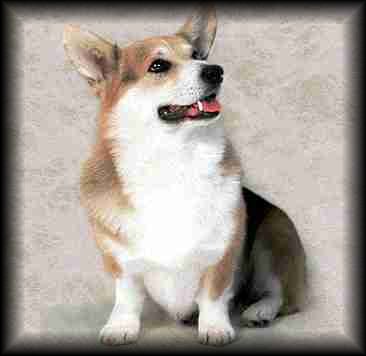
Although all evidence seems to point to the fact that the Pembroke Welsh Corgi is a much younger dog than the Cardigan Welsh Corgi, it is still true that the Corgi from Pembrokeshire is a breed of considerable antiquity. No breed that traces its origin back to A.D. 1107 can be regarded as an especially new type of dog.
In modern times there has been an effort to link the two types of Corgi under the heading of a single breed. This is far from the truth, according to W. Lloyd-Thomas, the Welsh authority who has spent so many years digging out the history of these small cattle dogs. He has give some interesting information, that, while it tends to divorce the two Corgis definitely, still gives the Pembroke a colorful past.
The direct ancestors of the Pembroke were brought across the Channel by the Flemish weavers who had been induced by Henry I of England to take up their abode in Wales. This occurred in 1107, and its stands as a sturdy cornerstone upon which the development of a breed has been built. While weaving was one of their occupations, these Flemish people were also of an agrarian nature, and they soon had transferred to the southwest corner of Wales, at Haverfordwest, the replicas of the model homes and farms in their native land. The dog fitted into this scheme.
This early progenitor of the Pembroke Welsh Corgi of today has been described as having a noticeable resemblance to the old Schipperkes. It sprang from the same family that includes the Keeshond, the Pomeranian, the Samoyed, the Chow Chow, the Norwegian Elkhound, and the Finnish Spitz. It has little or nothing of the Dachshund characteristics.
In relation to the Cardigan, the Pembroke is shorter in body; the legs are straighter and lighter-boned, while the coat is of finer texture. Two of the most noticeable differences are in the ears and the tail. Cardigan ears are rounded, while the Pembroke's are pointed at the tip and stand erect. The Cardigan has a long tail, and the Pembroke a short one. In disposition, the Pembroke is more restless, more easily excited. If one could see specimens of the early members of both breeds at the same time, the differences would be very marked. In modern times they have become more similar. The whole development of the Pembroke evinces a desire on the part of its breeders to produce a lower, stockier dog. It also may be noted that the head has grown stronger, while in these times, good sized, round-tipped ears are not unusual.
The manner in which the Pembroke and the Cardigan have approached each other in appearance is not merely a matter of chance or of selective breeding. It is known, rather definitely, that the two were crossed before the middle of the 19th century.
The story comes direct from one of the old crofters, a man of nearly ninety years, who spent his whole lifetime in Bronant. It seemed that in his youth, many of the young people in that village found a manner of increasing their pocket money. There were always plenty of the Cardigan puppies; in fact, the majority were a burden on the poor tenant farmers. If these puppies were retained, they would cost money to feed. One day an enterprising young man tucked a couple of Corgi puppies under his arm and set forth into a neighboring shire. When he returned there was the jingle of coins in his pocket. Thereafter, other young men followed the example. The old hillman who relates this incident says that he sold puppies to the farmers in Carmarthenshire and in Pembrokeshire.
It is not known whether any Cardigan Corgis had gone into Pembrokeshire at an earlier date, but it is quite possible, and it is only logical that if the two breeds were in the same section they would be bred together at some time. So far as known, the Pembroke was not taken into Cardiganshire up to the time of World War I, although since then there have been many instances of intermatings.
The two breeds of Corgi were mated together frequently at the time when these dogs first came to the consciousness of the bench-show fanciers. Little was known about either dog, and crossings were common. This practice has been stopped and breeders today are determined to keep the Pembroke distinct from the Cardigan.
The Pembroke is one of the most agreeable of small house dogs. It has an affectionate nature, but does not force its attentions upon those unwilling to accept them. Its intelligence is undoubted, and it is a remarkably alert, ever-vigilant guard of the fireside.