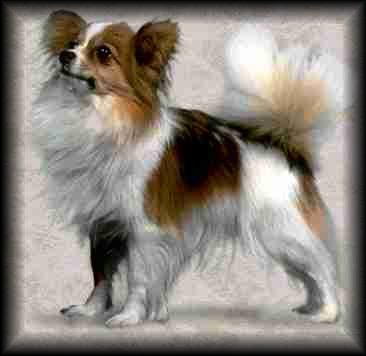
The Papillon, known in the 16th century as the dwarf spaniel, is the modern development of those little dogs often seen pictured in rare old paintings and tapestries. Rubens, Watteau, Fragonard, and Boucher all depicted them, and their popularity was so great that noble ladies of the day did not consider their portraits complete unless one of these elegant little dogs was pictured with them. Madame de Pompadour was the proud possessor of two, Inez and Mimi by name. Marie Antoinette was another ardent admirer, while as early as 1545 there is record of one having been sold to a lady who later ascended the throne of Poland.
It is Spain that we have to thank for the Papillon's primary rise to fame, though Italy, particularly Bologna, probably developed the largest trade. Many were sold to the court of Louis XIV, who had his choice among those brought into France. Prices ran high, and the chief trader, a Bolognese named Filipponi, developed a large business with the court of France and elsewhere. Most of the dogs were transferred from one country to the other upon the backs of mules.
As time went on, a change developed in the dwarf spaniel which gave rise to the present-day name, Papillon. During the days of Louis the Great, the dwarf spaniel possessed large, drooping ears, but gradually there came into being an erect-eared type, the ears being set obliquely on the head and so fringed as to resemble the wings of a butterfly. (Papillon is the French word for butterfly.) The causes of this change remain largely theoretical, but whatever they may be, we now have a Toy dog whose type of body and coat is about the same as that of the original dwarf spaniel of Spain and Italy, but whose ears may be either erect or drooping. Both types may, and often do, appear in the same litter. In continental Europe, as well as Great Britain, the drop-eared variety is called Epagneul Nain, although the breed as a whole carries the nomenclature of Papillon, as it does in this country. Here both types are judged together and with equality. Another change concerns color. Originally, almost all were of solid color. Today white predominates as a ground color, with patches of other colors, and solid-colored dogs are disqualified.
Papillons are hardy dogs. It is unnecessary to coddle them in winter; and they do not suffer particularly in severe hot weather. They delight in country activities and are equally contented in apartments. As ratters, they are extremely useful. Too small to kill a rat outright, they will worry it until it is exhausted, then dispatch in quickly. As a rule the bitches whelp easily and give little trouble when rearing puppies.
Although they have been exhibited for many years in the United States, it was not until 1935 that Papillons were represented in the American Kennel Club by their own breed club, the Papillon Club of America.