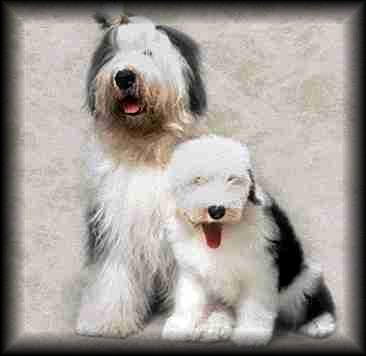
While as compared with some other kinds of dogs the Old English Sheepdog cannot boast the same antiquity, there is nevertheless ample evidence that it can trace its origin to the early 19th century or at least 150 years back, thus proving that among recognized breeds it is no mere upstart. As to its real origin, there are conflicting ideas based on premises obscured by the passage of time. A painting by Gainsborough of a Duke of Buccleuch, from which engravings were struck off in 1771, shows the peer with his arms clasped about the neck of what appears to be a fairly good specimen of present-day Old English Sheepdog. This is the earliest picture known that in any manner depicts the breed. What, however, the pictured dog was supposed to be at that period is not certain.
In all probability the breed was first developed in the west of England, in the counties of Devon and Somerset and the Duchy of Cornwall, although from what breeds it was produced is a matter of conjecture. Some maintain that the Scotch Bearded Collie had a large part in its making; others claim for one of its progenitors the Russian Owtchar.
At all events, in the beginning of the 18th century, we read of a "drover's dog" which was used largely for driving sheep and cattle into the markets of the metropolis. These drover's dogs were exempt from taxes and, to prove their occupation, they were docked. Some believe that the nicknames "bob" and "bobtail" trace to this custom. It is not true, of course, that the practice of removing the tail has produced a breed naturally bobtailed or tailless. In fact, few specimens of the breed are whelped without tails, or with tails long or comparatively short. According to the Standard, the tail should be removed at the first joint, when the puppy is three or four days old, and it should never be longer than one and one half or two inches in length at maturity. Seldom is an Old English Sheepdog seen in the show ring today with more than a mere thickening of the skin where the tail has been removed. Since this dog has been used more for driving than for herding, the lack of a tail to serve as a rudder, so to speak, has in no wise affected its working ability with heavier kinds of sheep and cattle.
For years after the breed's introduction into this country, fanciers did considerable harm by misinterpreting "profuseness" of coat as identical to "excessiveness." This misled the public into believing that the Old English Sheepdog was difficult to care for, when as a matter of fact a dog with typical coat of the right texture is no harder to keep in shape than is any other longhaired dog. Furthermore, it is homeloving, not given to roaming and fighting, and it is extremely agile; because of its intelligence, affection, and lack of boisterousness, it makes an ideal house dog. It has a tender mouth and can be trained as a retriever; it makes a first-class sledge dog, and is satisfactory as a companion equally at home in an apartment, large house, drawing room, and practically anywhere else.
In seeking a good representative of the breed, points to look for include a body practically square; good bone, deep brisket, and chest, and spring of rib; strong foreface, dark or walleyes, level teeth; straight forelegs, well-let-down hocks; and a hard coat with good underjacket. Markings are not important. The dogs do well under almost any climatic conditions, their coats serving as insulation against heat, cold, and dampness. A marked characteristic of the breed is its gait, which is quite like the shuffle of a bear.
The Old English Sheepdog Club of America was started by W. A. Tilley in 1904, and received official recognition by AKC the following year.