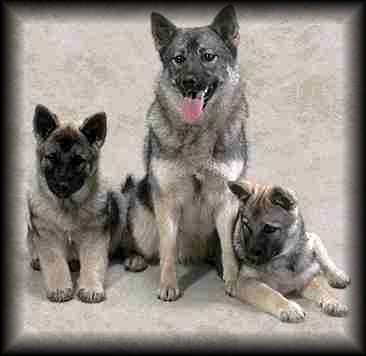
Comrade to the Vikings, guardian of lonely farms and saeters, herder of flocks and defender from wolves and bear, a hunter always and roamer with hardy men, the Norwegian Elkhound comes down to us through more than six millennia with all his Nordic traits untainted, a fearless dog and friendly, devoted to man and the chase. We read of him in sagas, we find his remains by the side of his Viking-master along with the Viking's weapons--sure proof of the esteem in which he was held; and in the Viste Cave at Jaeren, in western Norway, his skeleton was uncovered among the stone implements in a stratum dating from 4000 to 5000 B.C.
Selected and bred for his ability to accomplish a definite purpose, the Elkhound achieved his distinctive type by natural methods. No form was imposed upon him; he was not squeezed into a preconceived standard; his structure and rare beauty, like those of the thoroughbred horse, were evolved from the tests of performance. Every physical characteristic is the expression of a need. His compactness, his muscled robustness, his squareness, his width and depth are true expressions of nature's requirements for a dog that would hunt day after day, all day long, in rugged country, where stamina rather than extreme speed is called for.
For, though the Elkhound is foreign countries has become known and loved chiefly, perhaps, for his engaging and sensitive qualities as a comrade of man and his reliability and quickness to learn and adapt himself to any circumstances and conditions, it should never be forgotten that from first to last he has been at all times the peerless hunter of big game.
Many years ago, bear were still common in Norway, but today they are almost extinct, and the native dog's main use is the hunting of elk. (Elk is incorrectly used in the United States for the Wapiti, Cervus Canadensis, and our moose is a true elk.) A century ago, Captain Lloyd, an English sportsman, a mighty hunter and a fascinating writer, devoted his leisure to the description of bear hunting in Norway; and from that time on, everyone that has seen the Elkhound work in the forests of his native land has added to his praise.
The Elkhound's highly developed senses amount almost to intuition. It is common to read of, or--if one is fortunate-- experience such incidents as seeing a seasoned dog take body scent at from two to three miles or to hear him indicating to his master by a slight whimpering that the elk has become alarmed and has begun to run, at a time when no human senses can apprehend any sign by which the hound ascertains this fact.
Equally subtle is his method of engaging a bull. Knowing well that an elk can outfoot him, he holds the animal by just enough barking to attract his attention. Even with a skillful dog, however, the elk often moves on before the hunter can get up over the steep countryside; and in that case, the dog, aware that the bull, if not excited by sound or scent, will soon pause, works silently and very carefully up wind until he is once more with his quarry. After a while, the bull, becoming angry at the small beast annoying him, begins to attack with a wide sweeping movement of the great antlers and by striking with his deadly forefeet. But now, the Elkhound, short-backed so that he can, to use Herr Aarflot's apt expression "bounce like a rubber ball" jumps nimbly in and out, while giving full and furious tongue so that his high-pitched voice will reach his master.
The Elkhound is well adapted to the hunting of any other four-footed game and soon becomes expert on lynx, mountain lion, and raccoon. Sir Henry Pottinger declares that he is also an excellent tracker of fox. The same authority states:
"There is no more deadly way of approaching capercailzie, black game, and other forest birds than with a dog of the breed under discussion, held or fastened to the belt by a long leash and allowed to precede the hunter."
The Elkhound, then, is an exceedingly versatile dog developed through constant contact with man in pursuit of game. It was not until 1877 that he began to be considered from an exhibition point of view. In that year the Norwegian Hunters' Association held its first show, and shortly thereafter pedigrees, which had been handed down, were checked and traced as far back as feasible, a stud book (Norsk Hundestambak) was published, and a standard drawn up. Before that time, there had been some confusion of type owing to different developments in different parts of the country; but if we study the photograph of such a grand dog as that pillar of the stud book, known to fame as Gamle Bamse Gram (Old Bamse that belonged to Consul Gram), we shall see that all the essential elements of the modern show dog were already there, needing only a little refinement, a little emphasis.
At any rate, by the turn of the century, the breed was making very rapid progress, and, though there were few or no really large kennels, there were many expert breeders devoted to the Elkhound's improvement, and when the Norwegian Kennel Club (Norsk Kennelklub ) inaugurated its annual shows at Oslo, the Elkhound came into his own as Norway's great contribution to dogdom. Since then he has been exported in ever-increasing numbers; and his friendly disposition, his intelligence, his staunchness, his absolute dependability and trustworthiness, his eagerness to please, his sensitivity and his fearless confidence have gained for him everywhere a popularity based even more on his comradely character than on his unsurpassed abilities as a hunting dog.