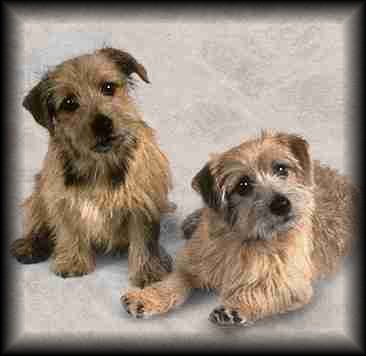
The Norfolk Terrier is small and sturdy, alert and fearless, with sporting instincts and an even temperament. Good natured and gregarious, the Norfolk has proved adaptable under a wide variety of conditions.
In England at the turn of the century working terriers from stables in Cambridge, Market Harborough, and Norwich, were used by Frank "Roughrider" Jones to develop a breed recognized by the English Kennel Club in 1932 as the Norwich Terrier. In the early days there was a diversity in type, size, color, coat and ear carriage. Correct color and ear carriage were constantly argued. When the Norwich breed standard was drawn up the drop ear and the prick ear terriers remained one breed. The English Kennel Club, in 1964, recognized them as two breeds--the drop ear variety as the Norfolk and the prick ear as the Norwich.
The year that the breed divided in England an article in The Field stated:
"Actually there is nothing new about the Norfolk Terrier, but simply the name under which it is registered. The Eastern Counties have always produced these principally wheaten, red and otherwise black and tan or grizzled good-ribbed short-legged terriers, built on the generally accepted lines of a hunt terrier. They go to ground readily and are famous ratters."
In the United States those who remember the "Roaring Twenties" still refer to the Norwich as a "Jones Terrier" after Frank Jones, from whom many American sportsmen traveling abroad bought their first little red terriers. In 1936, thanks to the efforts of Gordon Massey (who registered the first Norwich Terrier in this country) and Henry Bixby, then Executive Vice President of the American Kennel Club, the Norwich Terrier was accepted as a breed by the AKC. It remained one breed until 1979 when division by ear carriage became official. The drop ears are now recognized as the Norfolk, while the prick ears remain Norwich.
Visually there appears to be a distinct difference between the two breeds, resulting in two slightly different breed standards. Each breed has developed with success since separation.
Today, although as many live in cities as in foxhunting country, the Norfolk should still conform to the standard. The characteristic coat requires regular grooming but trimming is heavily penalized. The ears should be neatly dropped, slightly rounded at the tip, carried close to the cheek and not falling lower than the outer corner of the eye.
The Norfolk Terrier is essentially a sporting terrier--not a Toy. His chief attributes are gameness, hardiness, loyalty to this master, and great charm. He is affectionate and reasonably obedient. He must be kept small enough to conform with the standard. Above all, the outstanding personality, characteristic of the breed, must never be subordinated for the sake of conformation and appearance.