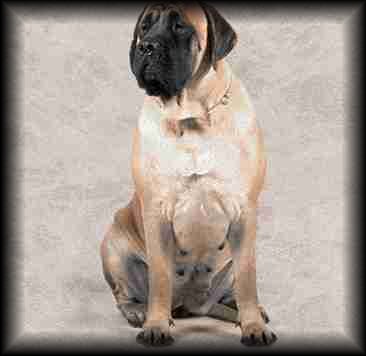
The breed commonly called "Mastiff" in English speaking countries is more properly described as the Old English Mastiff. It is a giant short-haired dog, with heavy head and short muzzle, which has been bred in England for over two thousand years as a watchdog. The term "mastiff" describes a group of giant varieties of dog rather than a single breed. They are supposed to have originated in Asia.
So little is known about dogs of any sort prior to a century ago that almost all theories of ancestry are of small importance. Every partisan would like to claim the greatest antiquity for his particular sort of Mastiff as well as to say that the other sorts sprang from it. There is very little proof one way or the other.
Cassel finds drawings on Egyptian monuments of typical Mastiffs dating about 3000 B.C. In literature, the earliest reference is in Chinese about 1121 B.C. So much for the undoubted antiquity of the Mastiff group's ancestry.
So far as the Mastiff is concerned, it has a longer history than most. Caesar describes them in his account of invading Britain in 55 B.C., when they fought beside their masters against the Roman legions with such courage and power as to make a great impression. Soon afterward we find several different accounts of the huge British fighting dogs brought back to Rome where they defeated all other varieties in combat at the Circus. They were also matched against human gladiators as well as against bulls, bears, lions, and tigers.
Today we are likely to think of such cruel spectacles as belonging only to the dim ages of the past, but this is not true. Dog fights, bullbaiting, and bearbaiting were respectable and popular forms of amusement in England and America little more than a century ago. Such brutalizing events were patronized by nobility and clergy in England, while public-spirited citizens left legacies so that the common folk might be entertained in this way on holidays.
Dogfighting and animal-baiting were made illegal in England in 1835, but for twenty years longer the law was little obeyed. American dog fanciers are interested in the word fancier, which was synonymous with bettor--meaning especially a bettor on a dog or prize fight--and are interested also in the name of one of the most fashionable sporting establishments in London, over a hundred years ago, called the "Westminster Pit," with 300 seats. Westminster meant "dogs" even then--but fighting dogs!
While the Mastiff was always in front rank as a fighting dog, this does not account for his popularity in England for two thousand years. It was as bandogs, or tiedogs (tied by day but loose at night) that they were found everywhere. In fact, long ago, keeping of these Mastiffs was compulsory for the peasants. During Anglo-Saxon times there had to be kept at least one Mastiff for each two villeins. By this means wolves and other savage game were kept under control. They were also used in hunting packs by the nobility. It was as protectors of the home, however, that they were most used, and probably as a result of centuries of such service the Mastiff has acquired unique traits as a family dog.
That the Mastiff has long been numerous is indicated by the development of the English language itself. The ancient word in Anglo-Saxon and in over a score of kindred languages for a member of the canine race is hound or something very similar. A rather modern word coming from the Latin languages is like dog, but in all but English it means a Mastiff sort. So we can believe that when the Normans conquered the Anglo-Saxons in 1066 and made Norman-French the official language of England, dogues (or Mastiffs) were so plentiful that people forgot eventually there was any other name for a canine creature. This is the only explanation a dog man can offer for such a peculiar change in a language.
Anecdotes extolling the power and agility of Mastiffs as well as their devotion to their masters would fill a large volume of marvels. Herodotus tells of Cyrus the Great, founder of the Persian Empire about 500 B.C., who received a Mastiff as a gift from the King of Albania. Cyrus matched the dog against another and also set it against a bull. But the Mastiff was meek, so Cyrus in disgust had it killed. News of this reception of his gift came back to the King of Albania. He sent messengers with another Mastiff--a bitch--to Cyrus, telling him that a Mastiff was no ordinary cur and that it scorned to notice such common creatures as a Persian dog or a bull. He urged him to select a worthy opponent such as a lion or even an elephant. The King of Albania concluded by saying Mastiffs were rare and royal gifts and that he would not send Cyrus another. Whereupon, says Herodotus, the Mastiff bitch was set to attack an elephant and did so with such fury and efficiency that she worried the elephant down to the ground and would have killed it.
That is probably the tallest Mastiff tale on record! However, it gives proof of the reputation of Mastiffs as powerful, agile, and courageous dogs. It is even more interesting to know that Albania was the land of the people known as Alani, an Asiatic race. Also that similar names stand for "mastiffs," e.g. Alano, Alan, and Alaunt.
The story of Sir Peers Legh, Knight of Lyme Hall (near Stockport, Cheshire) at the Battle of Agincourt, October 25, 1415, is well-known. He had brought his favorite Mastiff--also a bitch--to France, and when he fell, she stood over him and defended him many hours until he was picked up by English soldiers and carried to Paris, where he died of his wounds. The faithful Mastiff was returned to England and from her is descended the famous Lyme Hall strain which the family has bred over a period of over five centuries. In the drawing room of the castle is still to be seen an old stained-glass window portraying the gallant Sir Peers and his devoted Mastiff.
The present-day English Mastiff is based on the strains of Lyme Hall and that of the Duke of Devonshire's Kennels at Chatsworth. Chaucer writing in Middle English (a language resulting from a cross between old Anglo-Saxon and Norman-French) 300 years after the Norman Conquest, described the Old English Mastiff in his "Knight's Tale." He tried to use the Italian-French word for Mastiff, Alan, which is still used in English heraldry to describe the figure of "a Mastiff with cropped ears" on a coat of arms:
Aboute his char ther wenten white Alaunts Twenty and mo, as gret as any stere To hunten at the leon or the dere.
So here is proof that 600 years ago Mastiffs were hunted in packs in England on such different game as lion or deer. Chaucer says they were as large as steer! Even though cattle were much smaller in those days, this is hard to credit. The white color is authentic. We have plenty of pictures and descriptions of white and piebald Mastiffs, often with long coats, of about a century ago.
The American Mastiff Club was formed in 1879, and some time thereafter disbanded. In 1920, the first Mastiff Club of America was founded and the present Club was established in 1929.