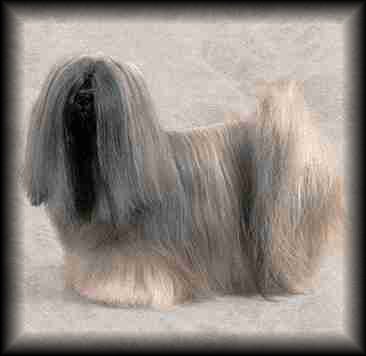
Beyond the northern boundary of India, where the mighty Mount Everest stands like a guardian sentinel, is the mysterious land of Tibet. It is a country of huge mountains and deep valleys, with a climate of intense cold and great heat, a country where conditions are hard on man and beast. This is the home of the Lhasa Apso, known in that land as Abso Seng Kye, the "Bark Lion Sentinel Dog." Small wonder, then, that these members of dogdom should be of such hardy and vigorous constitution.
Since danger threatened from without and within in this strange land, a huge Mastiff was chained to a post beside the outer door to prevent intruders from entering, while Lhasa Apsos was kept as special guards inside the dwellings. for this work the little dogs were peculiarly adapted by their intelligence, quick hearing, and finely developed instinct for distinguishing intimates from strangers.
The Lhasa Apso, from the lamaseries and villages around the sacred city of Lhasa, is one of three breeds native to Tibet that are in the Non-Sporting Group. The others are the Tibetan Terrier and the Tibetan Spaniel. The breeds have two characteristics in common, namely, the heavy coat of hair to protect them from the rigors of the climate, and the tail upcurled over the back.
Of the three, the Lhasa was the first admitted to AKC registration--in 1935. It was originally shown in the Terrier Group, then reassigned to the Non-Sporting in 1959.
C. Suydam Cutting, naturalist, world traveler and compatriot to some of the more noteworthy men of his generation, is singularly credited with the establishment and reputation of the Lhasa Apso in America. During a trip to Tibet, Mr. Cutting was able to arrange an audience with the then 13th Dalai Lama, and a lasting friendship was formed. The Cuttings' first pair of Lhasas arrived in 1933 as a gift from the Dalai Lama.
The little Lhasa Apso has never lost his characteristic of keen watchfulness, nor has he lost his hardy nature. These two features should always be developed, since they are of outstanding merit. We have found that these dogs are easily trained and responsive to kindness. To anyone they trust they are most obedient, and their beautiful dark eyes are certainly appealing as they wait for some mark of appreciation for their efforts.