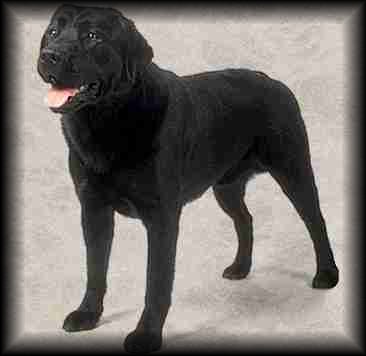
The Labrador Retriever did not, as his name implies, come from Labrador, but from Newfoundland, although there is no indication of by what means he reached the latter place. However, in 1822 a traveler in that region reported a number of "small water dogs" and said:
"The dogs are admirably trained as retrievers in fowling, and are otherwise useful . . . The smooth or short-haired dog is preferred because in frosty weather the long-haired kind become encumbered with ice on coming out of the water."
Early in the 19th century the Earl of Malmesbury reputedly saw one of the dogs that had been carried to England by fishermen and immediately arranged to have some imported. In 1830 the noted British sportsman Colonel Hawker referred to the ordinary Newfoundland and what he called the St. John's breed of water dog, mentioning the former as
"very large, strong of limb, rough hair, and carrying his tail high." Referring to what is known now as the Labrador, he said they were "by far the best for any kind of shooting. He is generally black and no bigger than a Pointer, very fine in legs, with short, smooth hair and does not carry his tail so much curled as the other; is extremely quick running, swimming and fighting . . . and their sense of smell is hardly to be credited. . . ."
The dogs were not at first generally known in England as Labradors. In fact, the origin of the name is shown in a letter written in 1887 by an Earl of Malmesbury in which he said:
"We always call mine Labrador dogs, and I have kept the breed as pure as I could from the first I had from Poole, at that time carrying on a brisk trade with Newfoundland. The real breed may be known by its close coat which turns the water off like oil and, above all, a tail like an otter."
The Labrador gradually died out in Newfoundland on account of a heavy dog tax which, with the English quarantine law, practically stopped the importations into England. Thereafter many Labradors were interbred with other types of retrievers. Fortunately, however, the Labrador characteristics predominated. And finally fanciers, desiring to stop the interbreeding, drew up a standard so as to discourage crossing with other retrievers.
There is a stud book of the Duke of Buccleuch's Labrador Retrievers which made it possible to work out pedigrees of the two dogs that did most to produce the modern Labrador, Mr. A.C. Butter's Peter of Faskally, and Major Portal's Flapper. These pedigrees go back as far as 1878.
The Labrador Retriever was first recognized as a separate breed by the English Kennel Club in 1903. The first registration of Labradors by the American Kennel Club was in 1917--Brocklehirst Nell, a Scottish bitch import. From the late 1920s through the 1930s there was a great influx of British dogs (and Scottish retriever trainers) that was to form the backbone of the breed in this country.
In England, no Labrador can become a bench show champion unless he has a working certificate, too-- testament that he has also qualified in the field. In America, the Labrador became primarily a retriever trial and shooting dog, but the dual concept of retriever excellence combined with good looks, style and proper type was established early. The fanciers of the 1930s who started the retriever trials--The Labrador Retriever Club (U.S.) was organized in 1931--also exhibited their field dogs at the bench shows with marked success.
The Labrador Retriever's capabilities, fine temperament, and dependability have established it as one of the prime breeds for service as a guide dog for the blind, or for search and rescue work.