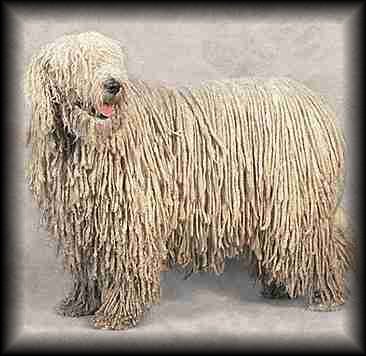
Of the three breeds of working dog native for ten centuries to the sheep and cattle countries of Hungary, there seems little doubt that the king of them all is the Komondor. This heavily coated dog is an almost direct descendant of the Aftscharka, which the Huns found on the southern steppes when they passed through Russia. Many of today's Komondorok (plural) bear striking resemblance to the massive, long-legged Russian herdsman's dog, but the breed generally has become more compact.
The Komondor is a mighty fellow. His head is impressive in its generous formation, and his general appearance is commanding. At first sight he is likely to create fear. Strangers of evil intent have reason to be fearful, but he is a devoted companion to his master and readily mingles with friends of the master.
One often sees pictures of the Komondor that show him with a heavily matted coat and with his head covered all over with long hair. The dog thus seems unkempt, and this is the way he is found in his habitat, where he lives in the open practically all the time. Under such circumstances, it would be impossible for the Komondor to have a well-groomed appearance, but he responds readily to care. When reared in kennels and prepared for shows, he is a handsome dog.
The Komondor is the chief of the herdsman's dogs, but he is not often utilized for rounding up the herds. He merely accompanies the flocks and herds in exceptional cases, and then more in the capacity of protector than as herder. His vigilance and courage have earned him a rather enviable position of trust, and much of the routine work is left to the smaller dogs.
The Magyars who have bred the Komondor for more than a thousand years attend principally to their herds and flocks and do not concern themselves with keeping pedigrees of their dogs. However, there is no need of pedigrees for them, as the dogs are not permitted to mate outside their own breed.
It is doubtful if any dogs with pedigrees could be found in the so-called Puszta, for the shepherds and herdsmen do not look upon dog breeding either as a commercial venture or as a hobby. Still, the crossing of a Komondor and a Kuvasz would be unimaginable, and also practically impossible. The Komondor still resides in the Puszta, while the Kuvasz has become, in recent times, more the watchdog of the village.
The history of pure-bred dog breeding in Hungary is not unlike that of any other country in the world. Definite records go back hardly a century, but those in existence are soundly attested by reliable parties. The Hungarian Kennel Club and the Hungarian Komondor Club maintain a strong control over the interests of the Komondor, these organizations having accepted the Standard of the breed as drawn up by a committee made up of members of the two clubs. The American Kennel Club's standard of the breed is a translation of the Hungarian.
In reading the standard, it should be noted that its salient points denote the strength and protective features that have been bred into the Komondor for centuries, and these should be maintained. Today there is not perhaps as pressing a need for such a self-reliant dog as there was in the past. In times of old he had to be ready at any moment to fight all manner of beasts of prey, many of which were his superior in size and weight. When the odds were against him, he could depend to some extent on that heavy coat to cover his most vulnerable points, and could call, too, upon an intelligence far superior to that of his wild adversaries.