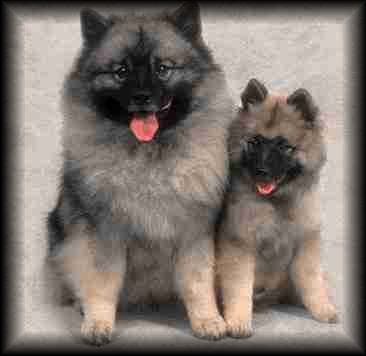
It took a national political turnover in Holland to bring the Keeshond (pl. Keeshonden) to wide attention in the latter part of the 18th century, but the breed had been one of the favorite dogs of the Dutch people for several hundred years before that. Never a hunter, and never used for any of the specialized forms of work that have characterized so many other breeds, the Keeshond had managed by the very force of his personality to win a high place in the affections of a nation.
The events leading up to the recognition of the Keeshond as the national dog of Holland were concerned with the social unrest that seemed to be spreading like a prairie fire throughout the world in the years immediately preceding the French Revolution. Holland was divided into two great camps, the Prinsgezinden or partisans of the Prince of Orange, and the Patriotten or Patriots.
The Patriots, consisting principally of the people of the lower and upper middle classes, were led by a man named Kees de Gyselaer, who lived in Dordrecht. Like most of his countrymen, de Gyselaer was a dog lover, and at the time he owned a little dog that he called Kees. This dog gave the breed its name, for it became the symbol of the Patriots. It appeared in countless pictures and cartoons made in those days of civil strife. The men who composed the party were firmly of the opinion that their own spirit was typified in the dog. He was a dog of the people.
Histories are rather vague as to what name the Keeshond bore prior to its adoption as a symbol by the Patriots, but it was known mainly as the barge dog. The breed had served for countless years on the rijnaken, or small vessels that were found in great numbers on the Rhine River. These vessels seldom were larger than 200 tons at the time when the Keeshond enjoyed its greatest popularity in Holland, and thus consequently would not accommodate a very large dog. There probably were more of this breed of dog kept as pets and watchdogs throughout the Netherlands than there were dogs on the barges. It was only natural that the dogs of the barges became better known, for they were continually moving up and down the river, coming in contact with more people.
The origin of the Keeshond is Arctic, or possibly Sub-Arctic, and it is of the same strains that produced the Samoyed, the Chow Chow, the Norwegian Elkhound, the Finnish Spitz, and the Pomeranian. It seems the most closely related to the Pomeranian. Some authorities believe that the Pomeranian was produced by selective breeding of the Keeshond.
The Keeshond has changed little in the past two centuries, for the earliest descriptions represent it as nearly identical with the dog of today. There also are a number of old paintings and drawings that prove how well the old Keeshond type has been preserved. A drawing, made in 1794, shows the children and the dog of a burgomaster mourning beside his tomb. The dog clearly resembles today's Keeshonden. Other evidence is found in the paintings of that famous Dutch artist, Jan Steen.
The close link between the Keeshond and the Patriots in the latter part of the 18th century almost proved the dog's undoing. He was so much in the public eye as the symbol of the Patriots that when the Prince of Orange established his party as the dominant one, few people wanted the dog that stood for the opposition. Many who owned Keeshonden disposed of them quietly; and only the most loyal maintained the breed. Then, the type of vessel used on the rivers gradually changed. Each year they seemed to get larger, until eventually, they were quite pretentious and had plenty of room for large dogs. This affected the popularity of the Keeshond considerably.
The breed was at a very low ebb until 1920, at which time the Baroness van Hardenbroek became so interested in the old breed that she undertook an investigation to see how much of the old stock still survived. The results of this search were very surprising. Whereas the breed had passed from public attention, it was still kept in its original form by certain captains of riverboats, by farmers, and by truckmen. There were many excellent specimens. Some owners had even maintained their own crude stud books.
The Baroness began breeding Keeshonden and spread their story throughout Europe. Within ten years she brought the breed to such a solid position that the Dutch Keeshond Club was established, and in 1933, De Raad van Beheer op Kynologisch Gebeid in Nederland accepted the standard for judging the breed.
As early as 1925, Keeshonden were in England and making a very good impression. The breed was accepted for registration by the American Kennel Club in 1930, and early development in this country, with few exceptions, was based on imports from England, which were in turn the product of British importations from Holland and Germany.
A handsome dog of well-balanced, medium size, with alert carriage and intelligent expression, the Keeshond is a hardy breed--with a "fur" coat that is easily taken care of. One of the most affectionate and lovable of all dogs, he has been bred for centuries as an "ideal family companion" and sensible watchdog.