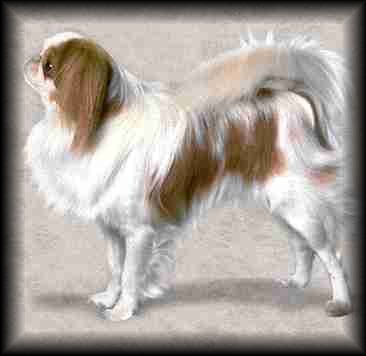
In Japan, there are Inu (dogs) and there are Chin. To the Japanese, the distinction needs no clarification. Chin are royalty. They are descendants of dogs that warmed the laps of Chinese aristocracy and kept court with the ladies of the Imperial Palace.
That the Japanese Chin is a very old Toy breed is attested to by the fact that dogs closely resembling them have been noted on the old Chinese temples as well as on ancient pottery and embroideries. Presumably these dogs originated in China, centuries ago, since it is reported that one of the Chinese emperors gave a pair to the emperor of Japan. They were kept in the hands of the nobility and frequently used as gifts of esteem to diplomats and to foreigners who had rendered some outstanding service to Japan.
When in 1853 Commodore Perry steamed into the harbor of Wraga and opened the country's trade to the world, he was presented with some of these dogs; then he in turn gave a pair to Queen Victoria. In time, specimens came to America, but there remains no record as to their final destination here. Others gravitated to this country as a result of thieving among Japanese kennels, when ships took the dogs all over the world. Every ship from the Orient carried several to ready buyers. Unfortunately, the dogs were not long-lived; World War I cut off the supply to America to such an extent that we had to use what we had to maintain and improve the breed. Japan, too, suffered losses among her prized Chin when earthquakes played havoc among her breeders. Since then Japanese fanciers have taken up other breeds and the supply of Chin has diminished. However, Japanese Chin are widely distributed, with breeders in England, France, Switzerland, Austria and Germany, where the high quality of the dogs has been maintained.
From its introduction until August 9, 1977, the breed was known and registered by the AKC as the Japanese Spaniel. Effective with that date, its name officially became the Japanese Chin.
There are different types of Japanese Chin. Essentially, though, the characteristic specimen must look Oriental; must be aristocratic in appearance, stylish in carriage. The larger dog is apt to lack these features, therefore only the small dog is considered of show type. Some specimens carry profuse coats, others shorter and coarser-textured coats; either is correct, but a woolly coat is not favored.
The majority of the dogs are black-and-white, although there are whites with lemon or red markings, including all shades from pale lemon to deep red as well as brindle. In each case the nose color must match the markings, with dark eyes regardless. Colors may be mixed within the litter in cases were the sire or dam is of other than pure black-and-white inheritance. Frequently a lemon-and-white produces only black-and-white offspring, and it may require several generations before the colors revert. Years ago, when a black-and-white dog had too much black on the body, a lemon-and-white mate was used in the hope of breaking the color in the next generation. The lemon-and-whites often had more profuse coats, so these were used to improve hair quantity as well as texture. It seems more difficult to produce a good lemon-and-white than a good black-and-white.
A Japanese Chin is a good companion, bright and alert. Naturally clean and game, too, he makes an ideal pet that can thrive in almost any climate. He is sensitive though, with definite likes and dislikes, but rarely, if ever, does he forget friend or foe.