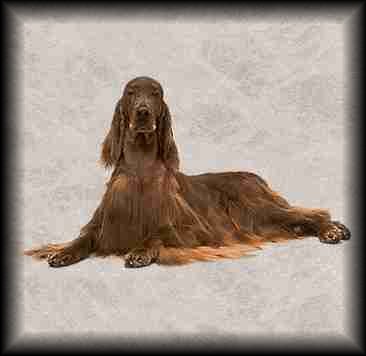
The Irish Setter first came into popular notice early in the 18th century and less than a hundred years later his reputation was firmly established, not only in his native Ireland but throughout the British Isles. Speculations as to his origin are little more than guesswork, various breeds having been named as his progenitors, but none that can boast a clear title to the honor. Among the conjectures is that he was developed from an Irish Water Spaniel-Irish Terrier cross, but it is far more believable that an English Setter-Spaniel-Pointer combination, with a dash of Gordon thrown in, was the true formula.
The Irish Red Setter was the name originally chosen by the Irish Setter Club of America to designate the breed in this country. His earliest ancestors in the Emerald Isle, on the contrary, were rarely self-colored dogs. By far the larger number were red and white, the white frequently predominating over the red, and even today many individuals across the water are parti-colored. In America, however, solid reds or reds with small and inconspicuous white markings are the only ones accepted as typical. The Irishman's rich mahogany coat is thoroughly distinctive and has done much to make its wearer the bench-show favorite he is today.
The solid red Setter, as distinguished from the red and white, first appeared in Ireland in the 19th century. Jason Hazzard of Timaskea, County Fermanagh, Sir St. George Gore, and the Earl of Enniskillen all bred self- colored dogs, and it is a matter of record that in 1812 the Earl would have nothing else in his kennels. A few years later Stonehenge wrote: "The blood red, or rich chestnut or mahogany color is the color of an Irish Setter of high mark. This color must be unmixed with black; and studied in a strong light, there must not be black shadows or waves, much less black fringes to the ears, or to the profile of the form." The mention of black in the above is significant as indicating the possibility of the Gordon cross already mentioned. Today this color is absolutely taboo and even a few black hairs are faulted at the shows.
So much for the external appearance of the Irish Setter; now for more important, if less obvious characteristics. The breed is essentially a sporting one, and it is as a gun dog, after all, that this flashy red fellow must stand or fall. The first individuals imported into this country were brought over for use on game and, in spite of the fact that our ruffed grouse, quail, and prairie chicken were new and strange to them, they made good immediately. Elcho, imported in 1875 and one of the first of his breed to make a reputation for himself and his progeny in the United States, was not only a sensational success on the bench, but a thoroughly trained and capable shooting dog. To quote A.F. Hochwalt, in his book The Modern Setter, "All through the early field-trial records we find the Irish Setter holding his own with the 'fashionable blue bloods.' Had the Irish Setter fanciers continued on, their favorite breed would no doubt now be occupying a place as high in field trials as the other two breeds"; by which he means, of course, the English Setter and Pointer.
But the Irish Setter men didn't continue on, insofar as field trials were concerned, with the result that the Llewellin Setter and the Pointer have practically cornered the market in public competition in that field. Yet, in spite of this handicap, the red dog from Erin has lost none of the attributes of the good hunting companion, and given a fair chance, can and does demonstrate his quality as a high-class gun dog on all kinds of game. Strange as it may seem, his good looks have been his undoing in a way. His fatal gift of beauty, together with his gaiety, courage, and personality, have made him an ideal show dog. For this reason many fanciers have yielded to the temptation to breed for the bench only and to sacrifice to this most worthwhile object, field ability equally worthwhile and in no way incompatible with proper color, good size, and correct breed type.
Just a word regarding the characteristic personality of the red dog. First and foremost, he is typically Irish, with a devil-may- care something about him that not only makes him tremendously likeable but also adds to his value as a bird dog in rough country and briars. He is bold and at the same time gentle and lovable and loyal. He is tough--good and tough. He can stand continued work in the brush, is almost never stiff or sore, has the best of feet and running gear, and almost never gets "sour" when corrected in his work. He is not an early developer and frequently requires more training than some other breeds, but he is not as a rule headstrong in the sense that he is hard to handle in the brush. His outstanding fault as a field- trial performer is that he is not independent enough and pays too much attention to his handler. In reply to the criticism that he develops slowly, it is only fair to say that, once trained on birds, he is trained for the rest of his life and does not require a repetition of the process every fall. When you own a good Irishman, you own him for many years, every day of which you can be proud of his appearance, his personality, and his performance.