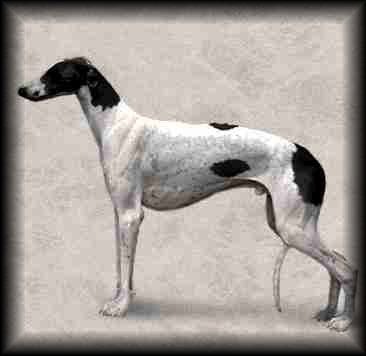
Swift as a ray of light, graceful as a swallow, and wise as a Solomon, there is some basis for the prediction that the Greyhound is a breed that will never die. His fame, first written in the hot sands of Egypt, can be traced in the varying terrains of almost every country, on every continent on the globe. His was the type the ancients knew, and from time immemorial he has been a symbol of the aristocracy. Yet the Greyhound is a dog that needs no fanfare to herald his approach, no panoply to keep him in the public eye. His innate qualities give him admittance to any circles, high or low.
The first knowledge of the Greyhound comes from the Tomb of Amten, in the Valley of the Nile, regarded by Egyptologists as belonging to the fourth dynasty, which in modern chronology would be between 2900 and 2751 B.C. The carvings in this old tomb show dogs of unmistakable Greyhound type in three separate scenes. In two they are attacking a deer, while in the other an animal with horns, somewhat similar to the American mountain goat. The dogs have ring tails.
The origin of the name "Greyhound" is somewhat open to dispute, and a number of suppositions have been advanced. One is that it is derived from Graius, meaning Grecian, because the dog was in high esteem among the ancient Greeks. Another conjecture is that it derives from the old British grech or greg, meaning a dog. Also, some say that it came to use because gray was once the prevailing color in the breed.
While the old Egyptian scenes establish the Greyhound as a recognizable type at a very early date, it is from a Roman source that there has come the first complete description of the breed. This was written by Ovid, who lived from 43 B.C. to A.D. 17. Reading this, one can have little doubt that the dog of ancient times is the same as the one of today. With certain allowances, it fits perfectly.
The Greyhound always has had a cultural and aristocratic background. He was the favorite of royalty in Egypt, and he was bred and raised in such luxurious surroundings that there was every reason for the oppressed races and the common people of those times to hate this dog. Yet the disposition of the dog was just as lovable and tractable then as it is today. Had the common people been allowed to own specimens of this dog, the story would have been entirely different, but his ownership was restricted to the ruling classes.
The ancient traditions connected with the Greyhound have come down throughout history. He is found in England at a very early date. In fact, a manuscript from the ninth century A.D. is illustrated with a picture of Elfric, Duke of Mercia; and beside this old Saxon chieftain stands his huntsman with a brace of Greyhounds. Just how many centuries before the time of Elfric the Greyhound was known in England is not known, but there is every reason to suppose that the breed had been there a long time.
The famous Canute Laws, written in Danish--for at that time the Danes had conquered much of what is now England--and enacted in a Parliament held at Winchester in 1016, give further evidence as to the status of the Greyhound. No. 31 of these Canute Laws states:
. . . No meane person may keepe any greihounds, but freemen may keepe greihounds, so that their knees may be cut before the verderons of the forest, and without cutting of their knees also, if he does not abide 10 miles from the bounds of the forest. But if they doe come any nearer to the forest, they shall pay 12 pence for every mile; but if the greihound be found within the forest, the master or owner of the dog shall forfeit the dog and ten shillings to the king. . . .
The Greyhound has been used on practically all kinds of small game from time to time, including deer, stags, foxes, and so forth, but the hare is his natural quarry, and coursing the sport with which he has been associated for centuries. In fact, coursing has been done on an organized basis in England for nearly two centuries.
The Greyhound came to America long before 1776. Laurel Drew, a historian of the breed, has traced Greyhounds that were brought to this country (along with Mastiffs) by Spanish explorers in the early 1500s "to guard, hunt, intimidate and punish their enemies--in this case, the Indians." The reports tell of Greyhound hunting prowess, of how they "went into the woods that were near and returned bringing hares and rabbits."
The Greyhound figures prominently in the journals of George Cartwright, an English explorer to Labrador in 1770. And Baron Freidrich von Steuben, the German professional soldier who was so helpful to General Washington in the American Revolutionary War, was always accompanied by a huge Greyhound named Azor.
One of the most celebrated of many Greyhound owners in history was General George A. Custer. Custer was especially fond of coursing breeds--Greyhounds and "staghounds"--and traveled with a hound pack that numbered about forty. One book reports that Custer's dogs were about to run a matched race the day before he left on his fatal expedition to Big Horn River in 1876.
Greyhounds were among the earliest at American dog shows, too. The catalog of the first Westminster Kennel Club show in 1877 includes an entry of 18 Greyhounds, and the breed was in the second edition of the AKC stud book (in 1885) with listings of three males and five bitches.
The invention of the mechanical lure by O. P. Smith in 1912, leading to the introduction of track racing for Greyhounds in the 1920s, added another--and sizeable--dimension to interest in the breed. This interest is as strong as ever today.