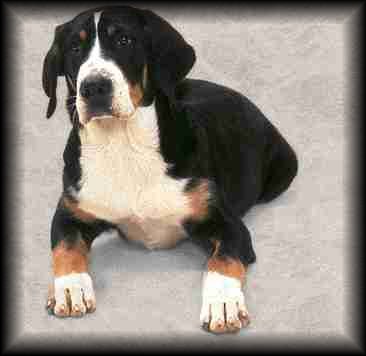
For centuries the Greater Swiss Mountain Dog or "Grosser Schweizer Sennenhund" was the most common working breed in its native country. "Sennenhund" means "dog of the Alpine pastures," and the "Grosser" is the largest of the four Swiss Sennenhunde, all of which are believed to be descendants of dogs brought by the Romans during their invasion of Helvetia. These dogs were of Mastiff type, developed by early man to be servant and friend.
Raised in an idyllic, pastoral environment, the "Swissy" as it is called short, developed a calm disposition and sound temperament. His willingness to work afforded the Alpine herdsman with a companion and he was often called upon to perform many farm chores other than herding and guarding. In fact, one task which he took to with unreserved joy was pulling carts. At one time, the Greater Swiss Mountain Dog was probably the best-known draft dog in the world.
As industrialization took over, however, the need for his services tragically diminished, and the breed nearly vanished. Then in 1908, a pure specimen was exhibited at a show in Langenthal, Switzerland. Luckily for the breed, the judge was the famous expert, Dr. Albert Heim of Zurich, who urged breeders to save the breed.
Consequently, the next two years saw concentrated efforts by breeders to rescue this Alpine herding dog. In 1910, the Grosser Schweizer Sennenhund was officially recognized by the Swiss Kennel Club, and the determined breeders formed the "Klub Fur Grosse Schweizer Sennenhunde."
In 1968, the first Greater Swiss Mountain Dogs were imported into the United States. The breed promises to be an ideal family dog with an innate ability to learn and serve.