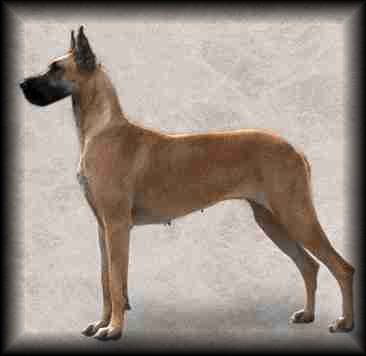
In appearance and nature the Great Dane is one of the most elegant and distinguished varieties of giant-type dog.
The name of the breed (in the English language) is a translation of an old French designation, grand Danois, meaning "big Danish." This was only one of half a dozen names which had been used for centuries in France. Why the English adopted the name "Great Dane" from the French is a mystery. At the same time the French were also calling it dogue allemand or "German Mastiff." "Mastiff" in English, dogge in the Germanic, dogue or dogo in the Latin languages, all meant the same thing: a giant dog with heavy head for fighting or hunting purposes. It was one of the dozen varieties of dog recognized as distinctive enough at that time to have a name of its own.
There is no known reason for connecting Denmark with either the origin or the development of the breed. It was "made in Germany," and it was German fanciers who led the world in breeding most of the finest specimens.
If the reader is susceptible to the charms of antiquity, he will be interested in Cassel's claim that on Egyptian monuments of about 3000 B.C. there are drawings of dogs much like the Great Dane. Also, the earliest written description of a dog resembling the breed may be found in Chinese literature of 1121 B.C. (an article by Dr. G. Ciaburri, Great Dane Club of Italy publication, 1929).
Eminent zoologists believe that the Mastiff breeds originated in Asia. They think the modern Tibetan Mastiff, occasionally shown in England, is the most direct descendant of the prototype.
The great naturalist Buffon (1707-1788) claimed the Irish Wolfhound as the principal ancestor of our Great Dane. The comparative anatomist Cuvier (1769-1832) found more evidence in favor of the old English Mastiff as the root from which it sprang. Both Irish and English breeds are known to have been carefully bred for 1300 years and more. Today most students favor the idea that the Great Dane, or Deutsche Dogge, resulted from a mixture of both these ancient types.
This is not to say that the German Mastiff or Great Dane is a new breed. It is, indeed, a very old one which has been cultivated as a distinct type for probably 400 years, if not longer. Like all old varieties of dog, it was developed for a useful purpose. The Germans used the Great Dane as a boar hound. Europe's erstwhile boar was one of the most savage, swift, powerful, and well-armed of all big game on the Continent. To tackle the wild boar required a superdog, and that is precisely what the Germans developed. We who fancy him speak of him as the king of dogs.
In common with all other breeds, the Great Dane's history of and development to a modern standard type began in the latter 19th century. In 1880 at Berlin, Dr. Bodinus called a meeting of Great Dane judges who declared that the breed should be known as Deutsche dogge and that all other designations, especially the term "Great Dane," should be abolished thereafter. So far as the German people are concerned this declaration has been observed, but English-speaking people have paid no heed. The Italians, who have a large Great Dane fancy, have also failed to give Germany credit for the name selected: alano. This word means "a mastiff," consequently the name of their organization means "Mastiff Club of Italy." This, however, has not prevented close cooperation between fanciers of the two countries. The leading Italian breeders have based their operation on nothing but German imported stock or its descendants.
In 1891 the Great Dane Club of Germany adopted a precise standard, or official description of the ideal specimen. In 1885, there was a Great Dane Club in England, and in 1889 at Chicago the German Mastiff or Great Dane Club of America was founded with G. Muss-Arnoldt as first delegate. Two years later the club reorganized as the Great Dane Club of America. At that time, its membership was mostly of Eastern fanciers.
The Great Dane has developed steadily in popularity all over the world. Breeders have kept before them the image of the boar hound and the special qualities it called for. A merely "pretty" dog has not been enough. He must have size and weight, nobility and courage, speed and endurance. What more can one ask for in a dog?