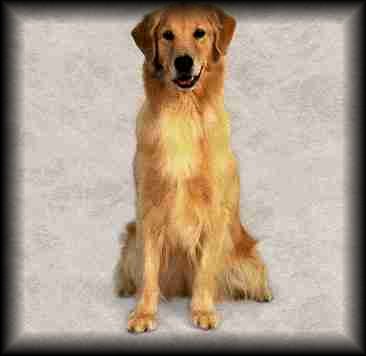
In the early 1800s game was plentiful in England and Scotland, and hunting was both a sport and a practical way of obtaining food. Retrievers came into prominence because of the desire for a medium-sized dog that would do well in wild-fowling, both water fowl and upland game.
The most complete records of the development of the Golden Retriever are included in the record books that were kept from 1835 until about 1890 by the gamekeepers at the Guisachan (pronounced "Gooeesicun") estate of Lord Tweedmouth at Inverness-Shire, Scotland. These records were released to public notice in Country Life in 1952, when Lord Tweedmouth's great-nephew, the sixth Earl of Ilchester, historian and sportsman, published material that had been left by his ancestor. They provided factual confirmation to the stories that had been handed down through generations.
The delightful story that had the "six circus-performing Russian Trackers" as antecedents for Golden Retrievers is only that--a story, one which gained wide circulation but has no basis in fact.
It is known that in developing the Golden Retriever a Tweed Water Spaniel was used. Also, a small, lighter-built Newfoundland. There were other crosses--Irish Setters, other water spaniels. Water retrieving was very important and hunters needed a strong dog that could withstand cold water, would be a good swimmer and could fend with the heavy vegetation in which upland game was found.
Lord Tweedmouth bought his first Yellow Retriever, Nous (i.e. Wisdom) in Brighton in 1865. Nous was said to have been bred by the Earl of Chichester. A photograph of Nous in about 1870 shows a biggish Golden with a wavy coat. Some paintings in the British Museum show dogs similar in type. Portrait painters often painted individuals and families with their favorite dogs.
The location of Guisachan on the Tweed River at Beauly, near Inverness, had a direct bearing on the program pursued by Lord Tweedmouth to produce the characteristics he desired in his Yellow Retrievers. Along the shores of this river was the Tweed Water Spaniel, the hardy type of spaniel used for retrieving. The dog was descended from the ruggedly built water dogs which for years had been used along the British seacoast by families who depended upon the courage, intelligence and ability of these animals to retrieve game under all sorts of conditions. According to Dalziel, author of British Dogs (1881), Tweed Water Spaniels were light liver in color, so close in curl as to give the idea that they had originally been a cross from a smooth-haired dog, long in tail, ears heavy in flesh and hard like a hound's--but only slightly feathered, forelegs feathered behind, hind legs smooth, head conical and lips slightly pendulous.
Though this variety of water spaniel has long since sunk into obscurity, its influence on the development of Golden Retrievers cannot be overlooked. The gamekeepers' books at Guisachan indicate that Nous was mated to a Tweed Water Spaniel named Belle in about 1867-68. Belle was liver-colored. At that time, liver was a term to describe any shade of brown to fawn or sand color. Nous and Belle produced four yellow puppies: Crocus, Cowslip, Primrose and Ada. Cowslip proved important in Lord Tweedmouth's plan to develop a Yellow Retriever. She was later bred to a Tweed Water Spaniel and a bitch puppy retained. In time, this dog was bred to a descendant of Ada. Yellow puppies were entered in the records from the breedings, breedings that included an Irish Setter and another Tweed Water Spaniel. It is believed that a Bloodhound was also used. Line breeding, not often used at this time, was a factor in developing the Golden Retriever, as Nous and Cowslip appear several times in the pedigrees.
Yellow or Golden Retrievers became popular in England toward the end of the 19th century. The first win of a field trial by a Golden Retriever took place in 1904.
Golden Retrievers were first shown in England at the Crystal Palace show in 1908, and were listed as Flat Coats (Golden). Others (also grouped with other retrievers as Flat Coats) were exhibited in 1909 and 1913. In 1913 they were given separate status by color and shown as Golden or Yellow Retrievers. Some enthusiasts formed the Golden Retriever Club (of England).
Travelers had taken some of the dogs with them on visits to America, and it is known that there were Golden Retrievers in the United States and Canada during the 1890s. Goldens from Great Britain and Canada were brought to both the East and West Coasts of the United States in the 1920s and 1930s.
The first registration of a Golden Retriever by the American Kennel Club was in November 1925. While there had been Goldens registered before that date, they had been registered as Retrievers with some description as to color. In Canada, their first registration as a separate breed was in 1927.
Goldens were furthered in the United States in the 1930s and 1940s. (The Golden Retriever Club of America was formed in 1938.) The dogs were predominantly used as hunters, though some were shown on the bench. The owners made a great effort and were conscientious breeders for they wanted sound, good looking dogs as hunters for the game that was then plentiful. More and more of these breeders began exhibiting their dogs in the show ring.
On the whole, the darker dogs were favored but there were some medium gold colors as well. Both dark and light dogs were run in English field trials and seen in the show rings in Scotland and England. The same was true in the United States and Canada, and remains true today. Balance, soundness , gait, trainability and temperament have ever been the first considerations for the knowledgeable fancier.
In England and Scotland the standard was changed in 1936 to allow the lighter as well as the darker colors. As more and more dogs were imported from England and Scotland to fill the American demand, the lighter colors were brought over along with the darker. While there have been some that have won, the very light dog is not well favored in the show rings in the United States, and such winners might have been the exceptions that won because of other qualities. There is a swing away from the very light dog by the American public, and as a rule they have not been favored by field trial people and hunters.
Golden Retriever clubs in the United States and other countries are taking active steps in maintaining the breed at its best. Today, Golden Retrievers are used successfully in field trials, hunting, obedience, as personal companion dogs and as guide dogs for the blind. The excellent nose which makes for good game finding and tracking has been useful in other areas, including narcotics detection.
The first three dogs of any breed to achieve the AKC Obedience Champion title, first available in July 1977, were all Golden Retrievers. The first (Ch. Moreland's Golden Tonka) was a bitch, the others were males. Both males and females have done well in field trials and hunting. Their size, their biddable temperament and their desire to please, are all part of why Golden Retrievers have increased so rapidly in popularity.