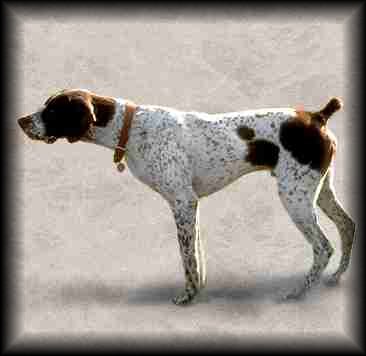
The German Shorthaired Pointer combines in field-dog requirements those qualities which have long popularized the various breeds of hunting dogs. So successfully have keen scenting powers, linked with high intelligence, been fused into the breed through judicious crossing of the descendants of the old Spanish Pointer, English Foxhound, and local German tracking hounds, and so varied are this dog's field accomplishments, that its adaptability has earned it the reputation of being an all-purpose dog. In fact, the term was applied to it by the Germans before United States sportsmen started importing the breed to any extent in the early 1920s.
It is indeed rare to find wrapped up in one package a staunchly pointing bird dog, a keen-nosed night trailer, a proven duck dog, a natural retriever on land and water, pleasing conformation and markings, great powers of endurance, and an intelligent family watchdog and companion. Indicative of this dog's versatility is its successful work on pheasant, quail, grouse, partridge, jacksnipe, woodcock, duck, rabbits, coon, and possum. It is also used to trail and handle deer. With a water-repellent coat and webbed feet, it retrieves well from rough terrain or icy waters.
The origin of the German Shorthaired Pointer, as indeed with most breeds, cannot be described precisely. Prior to the establishment of the Klub Kurzhaar stud book in the 1870s, few records are available, though the German hunting fraternity had already spent many years in attempting to produce a truly versatile utility dog-of-all-work, using of necessity the stock that was locally available. The main source of basic foundation stock seems to have been the German Bird Dog, a not very admirable step down by inheritance from the old Spanish Pointer. Its utility was further improved by introducing local types of scent hounds--track and trail dogs, that were also dependable in water and that were used by the German foresters. These Schweisshunde (Schweiss --scent; Hunde --dogs) were of many and diverse types. They had originated principally down through the centuries from the hounds introduced from Eastern countries after the Crusades, and had been developed particularly in France, so that they became the forebears of practically all present-day scenting hounds.
The Germans still were not satisfied. Since obedience was of paramount importance, these early dogs were selectively bred for bidability. Steps were taken later to improve stance, style, and, above all, nose. Fine Pointers were brought from England and were used to lend elegance to the manner of working--die hohe nase (the high nose) being the major aim. This was accomplished, and the breeders then had only the problem of ridding their developing Kurzhaar of its unwanted Pointer characteristics --aversion to water and lack of aggressiveness toward predators. These objectives were achieved long before the turn of the century. A dog breeding true to type was developed, giving the world at long last a magnificent utility dog combining these virtues with the good looks, sound temperament, and longevity that have made the German Shorthaired Pointer a favorite with sportsmen everywhere.
The German Shorthaired Pointer was first admitted to the stud book of the American Kennel Club in March, 1930. The first AKC licensed Specialty Show for German Shorthaired Pointers was held by the German Shorthaired Pointer Club of America at the International Kennel Club show in Chicago on March 29-30, 1941; the first AKC licensed Field Trial for the breed was also held by the parent club at Anoka, Minnesota, on May 21, 1944.