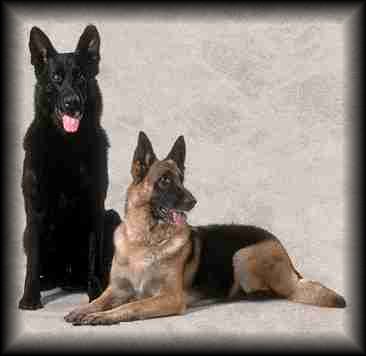
Derived from the old breeds of herding and farm dogs, and associated for centuries with man as servant and companion, the German Shepherd Dog has been subject to intensive development. Sponsored by the Verein fur Deutsche Schaferhunde, the parent club of the breed founded in 1899 in Germany, the cult of the Shepherd spread rapidly from about 1914 onward in many parts of the world. Interest in the breed has been fostered by specialty clubs in many lands as it has been in the United States by the German Shepherd Dog Club of America.
First, last and all the time a working dog, the German Shepherd Dog has been developed both temperamentally and structurally through selective breeding, through judging which on the whole has been of a conservative character, and through specialized training.
Considering first the more important side of the dog, its character, the Shepherd is distinguished for loyalty, courage, and the ability to assimilate and retain training for a number of special services. He should be of equable disposition, poised, unexcitable, and with well-controlled nerves. For his typical work as a herding sheepdog, he must not be gun-shy and must have courage to protect his flock from attacks, either animal or human. For his work as a police dog, a development which followed upon his natural aptitude for training, he must have this courage and in addition must be able to make use of the excellent nose which he usually possesses. In his work as a leader of the blind, the Shepherd must and does exhibit a high order of intelligence and discrimination involving the qualities of observation, patience, faithful watchfulness, and even, to a certain degree, the exercise of judgment.
These qualities, which have endeared the German Shepherd Dog to a wide public in practically every country of the globe, also make him a good companion, protector, and friend. The German Shepherd is not a pugnacious brawler, but can be a bold and punishing fighter if need be. In his relation to man he does not give affection lightly; he has plenty of dignity and some suspicion of strangers, but his friendship, once given, is given for life.
On the physical side, the German Shepherd Dog has been developed to a point of almost ideal fitness for the work he is called upon to do. He is a dog of middle size with enough weight to be effective as herder or patrolman, but not enough to be cumbersome or unwieldy.
By careful selective breeding, the naturally easy trot of the German Shepherd Dog has been brought to a high pitch of nearly effortless motion. Essentially a trotting animal, his structure has been modified so as to increase the power, elasticity and length of his gait. Other things being equal, the best-moving Shepherd is the one which covers the maximum amount of ground with the minimum expenditure of energy. So well coordinated and harmonious is this gait when properly exemplified that the dog seems to glide forward without visible effort--suspended, one might almost think, from the firm beam of his back.
The impression of the dog as a whole is one of ruggedness combined with nobility; of power combined with agility. There should be a sense of balance, with the forequarters and hindquarters compensating each other in their development. The outline should be smooth and flowing, and the topline of the dog, from the ear to the tip of the full tail, a single sweeping succession of unbroken curves. The German Shepherd Dog is a natural dog, unchanged for any whim of the show ring.