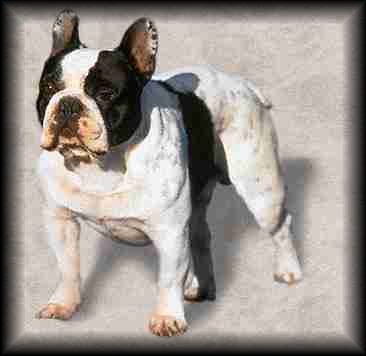
While there has been a difference of opinion as to the origin of the French Bulldog, it seems pretty well established that one ancestor must have been the English Bulldog--probably one of the toy variety, of which there were a great number in England around 1860. These toy Bulldogs, not finding favor with the English, were sent in large numbers into France. There they were crossed with various other breeds, and finally became popular in fashionable circles, particularly with women. It was then that they were given the name Boule-Dog Francais, although later on England scoffed at the idea of applying the word Francais to a breed so clearly showing a strong strain of English Bulldog. At that time there was little uniformity of type, and one found dogs with rose ears, while others had bat ears which have since come to be recognized as an outstanding feature of the French Bulldog.
There are two distinctive features in French Bulldogs: one, the bat ear, as above mentioned; the other, the skull. The correctly formed skull should be level, or flat, between the ears, while directly above the eyes, extending almost across the forehead, it should be slightly curved, giving a domed appearance. Both of these features add much to the unusual appearance of the French Bulldog.
The preservation of the bat ear as a distinct feature has been due to the persistent efforts of American fanciers, since in the early days of breeding these dogs in Europe the tendency was toward the rose ear. Had this movement not been opposed by America, the breed would eventually have lost the feature that so strongly accentuates its individuality, and the result would have been practically a miniature English Bulldog.
This controversy over type was directly responsible for the formation of the French Bulldog Club of America, the first organization in the world devoted to the breed. Fanciers gave a specialty show in the ballroom of the Waldorf-Astoria in 1898, this being the first of its kind to be held in such deluxe quarters. The affair proved a sensation, and it was due, no doubt, to the resulting publicity that the quaint little chaps became the rage in society. Show entries increased until the peak was reached in about 1913, when there were exactly 100 French Bulldogs benched at Westminster, while the following specialty shows had even more.
Unquestionably, the dog that made the most contributions to the establishment of the breed in America was Ch. Nellcote Gamin, imported in 1904 by Mr. and Mrs. Samuel Goldenberg. With the addition of Gamin to the splendid stock already in this country, we were made independent of further importation in order to produce the finest Frenchies in the world.
While bred principally as pets and companions, Frenchies are remarkably intelligent and serve as good watchdogs. They are affectionate, sweet-tempered, and dependable. Alert and playful, they are not noisy and, as a rule, bark very little. Their size is another advantage in considering them as indoor pets, and the smooth, short coat is easily kept clean.