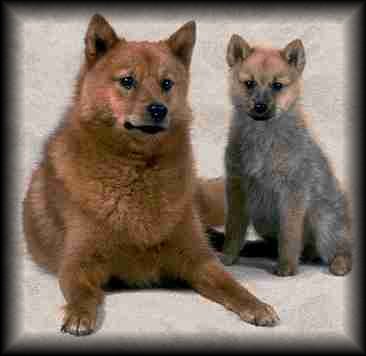
Suomenpystykorva, the Finnish Cock-eared Dog, was known in earlier times as the Finnish Barking Birddog. Now called the Finnish Spitz, it is the national dog of Finland.
The history of spitz-type dogs can be traced back several thousand years, to an era when the Finno-Ugrian people inhabited Central Russia. As various tribes migrated to different areas, they bred their dogs according to need, thus developing separate strains. One clan made its way to the far northern regions where, isolated among 60,000 lakes, the Finnish Spitz emerged as a pure breed and an invaluable asset to the hunter.
As centuries passed and advanced methods of transportation brought diverse populations and their dogs together, the original Finnish Spitz were mated with other breeds, until by 1880 they were nearly extinct. About that time two sportsmen from Helsinki, hunting in the northern forests, observed the pure native dogs, realized their many virtues, and returned home with superior specimens in an effort to salvage the breed.
One of the pioneers, Hugo Roos, became directly involved with the dogs and bred them for over 30 years; later he retired to devote his talents to judging. Another pioneer, Hugo Sandberg, launched an impressive rescue campaign in 1890, though he never actually bred Finnish Spitz himself. At the first Helsinki dog show, held in 1891, Mr. Sandberg judged and on that historic day five Finnish Spitz were awarded ribbons.
With the advent of dog shows, it became necessary to draw up a standard. Due to the success of Mr. Sandberg's promotion, the Finnish Kennel Club recognized the breed in 1892, with a standard based on his observations. In 1897, when the standard was revised in detail, Finnish Spitz became the official breed name.
In 1927 the first Finnish Spitz arrived in England, a pair brought back by Sir Edward Chichester following a hunting trip to Scandinavia. Among the early British devotees was Lady Kitty Ritson, who was instrumental in forming the breed club. It was she who coined the nickname "Finkie" by which the dogs are affectionately known in several countries. By 1935, the breed had sufficient adherents to warrant registration with the Kennel Club. Perhaps the most recognizable name among English supporters is that of Mrs. Griselda Price, whose Cullabine prefix is shared by many top winning dogs worldwide.
A native Finn, Ray Rinta, is credited with piloting the breed to Canadian Kennel Club recognition--the CKC admitted the Finnish Spitz to its stud book in 1974. Mrs. Joan Grant's dogs (Jayenn prefix) have been a major force in the breed's popularity "north of the border."
The first known Finnish Spitz imported to the United States was Cullabine Rudolph, from Mrs. Price's kennel in England, in 1959. It is believed, however, that breeding of the Finnish Spitz in the U.S. commenced in the mid-sixties from Finnish imports belonging to Henry Davidson of Minnesota and Alex Hassel of Connecticut.
The Finnish Spitz Club of America was founded in 1975 by Richard and Bette Isacoff with Margaret Koehler. The American standard for the breed was formulated by Mrs. Koehler and Mrs. Isacoff in 1976, based on the standard of the country of origin.
In November 1983, the breed was accepted into the Miscellaneous Class. The Board of Directors of the AKC opened the stud book for registration of the Finnish Spitz on August 1, 1987. Assigned to the Non-Sporting Group, the breed became eligible to compete at AKC licensed shows January 1, 1988.
Except in his native land, the Finnish Spitz is primarily a house dog, a faithful companion with particular fondness for children. In Finland, however, he is still a worker. He has functioned since earliest times as a natural bark pointer, who directs a hunter to the location of treed game by a distinctive ringing bark or yodel, and points at the prey with his head and muzzle when the hunter approaches. Ranging far into the forest, he seeks out the capercaillie (akin to our wild turkey) using sight, scent and sound, all the while keeping audio contact with the hunter. Flushing it from the bush, he follows it until it settles into a tree. Soft at first, then building to a crescendo, the dog's vocalizing alerts the hunter and draws him to the site. As he approaches, the dog gently sways his tail to and fro--this has a mesmerizing effect on the bird which has already been distracted by the barking. In Finland the hunting ability of the breed is so prized that no Finnish Spitz can earn a conformation championship without first proving his worth in the field. Of particular importance is the quality of his bark, and contests are held annually to select a King Barker.