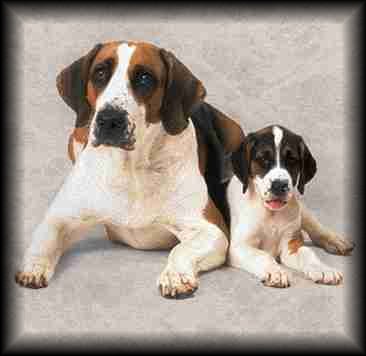
Foxhunting in the United States is almost contemporaneous with the sport in Great Britain. The Foxhound with which we are dealing is known in the United States in dog shows and elsewhere as the English Foxhound, though why it should be designated by that name any more than a Fox Terrier should be called an English Fox Terrier, is hard to understand. The English Foxhound has been bred along careful lines for over 150 years. The stud books published by the Masters of Foxhounds Association (of England) date back before 1800 and it is an easy matter for any owner of any English Foxhound to trace its pedigree back. The breeding of Foxhound in England has always been in the hands of masters of hounds, who kept the most careful records of their breeding operations.
For the benefit of those who may be interested in knowing how long the English Foxhound in his pure state has been in the United States, we find that there are records which establish that the first Lord Fairfax imported hounds from England in 1738, and there are unauthenticated records of even earlier importations. The English Foxhound Stud Book of America, published by the Masters of Foxhounds Association of America, dates its earliest entries back to 1890, but there are earlier records which would incline one to the belief that there were many earlier importations. Certainly the blood of the Genesee Valley pack must date at least twenty years before that time, records having been kept of it with fair accuracy ever since.
In England as in America these hounds have always been used for foxhunting as followed in the English fashion of riding to hounds. There have been over 250 packs of hounds in Great Britain, all of which used English Hounds, while in America we have over a hundred packs, of which not over 10% use hounds which would be eligible for the English Foxhound Stud Book, although the blood has been freely mixed with the American Foxhound.
In appearance the English Hound is far stouter than his American cousin, and perhaps no better description of his general appearance can be given than to quote a passage from Cuthbert Bradley's Reminiscences of Frank Gillard, in which he describes Belvoir Gambler '85, one of the greatest Foxhounds that was ever bred:
. . . Although Belvoir Gambler cannot be bred from rule of thumb, the proportions of this remarkable Foxhound are worth preserving as an example of what symmetry should be. Standing twenty-three inches at the shoulder, from the extreme point of his shapely shoulders to the outer curve of his well-turned quarters, he measured twenty-seven and a half inches in length whilst from elbow to ground his height was only twelve inches. Possessing great depth of rib and room round the heart, he girthed thirty-one inches, and his arm below was eight and a quarter inches round. Below the knee he measured eight and a quarter inches of solid bone, while round the thigh he spanned full nine and a quarter inches. The extended neck was ten inches from cranium to shoulder and the head ten inches and a half long. His color was of the richest, displaying all of the beautiful "Belvoir tan," and his head had that brainy appearance expressive of the highest intelligence. Gambler might have inspired that earnest poet, Cannon Kingsley, when he described the modern Foxhound, "The result of nature not limited, but developed by high civilization. Next to an old Greek statue there are few such combinations of grace and strength as in a fine Foxhound."
Although the tendency today is to breed hounds a little bigger, the above description cannot be equaled.