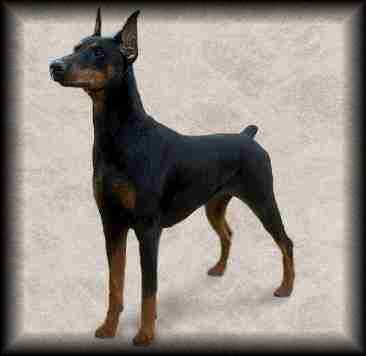
With its racial roots somewhat obscure, the Doberman Pinscher became within a comparatively short time a dog of fixed type, whose characteristics of both body and spirit have extended its popularity in many lands. Originating in Apolda, in Thueringen, Germany, around 1890, the breed was officially recognized in 1900. It takes its name from Louis Dobermann of Apolda.
Of medium size and clean-cut appearance, the dog at first glance does not give evidence of its great muscular power. So compact is its structure, so dense the laying on of muscle under the short coat, and so elegant and well chiseled the outline, that the novice would probably underestimate the weight by 15 to 20 pounds. Weight is the only particular, however, in which the Doberman is deceptive. Its qualities of alertness, agility, muscular and temperamental fire stand patent for any eye to see. It is an honest dog, uncamouflaged by superfluous coat or the wiles of the artful conditioner. One gains at once the impression of sinewy nimbleness, of the quick coordination of the well-trained athlete.
There is also an air of nobility about the Doberman Pinscher which is part of its birthright. More than most other breeds, it gives the impression of a blue-blooded animal, or aristocrat. From the strong muzzle and wedge-shaped head to the clearly defined stifle, the outline is definite and sharply etched. The fearless and inquisitive expression of the dark eye is in harmony with the bodily characteristics. The Doberman looks upon the stranger boldly and judges him with unerring instinct. He is ready, if need be, to give prompt alarm and to back his warning with defense of his master and his master's goods. Yet, he is affectionate, obedient, and loyal.
Traditionally compounded of the old shorthaired shepherd-dog stock, with admixtures of Rottweiler, Black and Tan Terrier, and smooth-haired German Pinscher, the Doberman has been fortunate, with the aid of selective breeding, to have absorbed the good qualities of the breeds which have contributed to its heritage. It has been from the beginning a working dog devoted to the service of mankind.
The properly bred and trained Doberman has proved itself as friend and guardian. As it developed, its qualities of intelligence and ability to absorb and retain training brought it into demand as police and war dog. In this service its agility and courage make it highly prized. An excellent nose adapted the dog to criminal trailing; it has also led to its use as a hunting dog.
In the United States the breed's popularity has been fostered by the Doberman Pinscher Club of America, which was founded in February 1921. Through the efforts of this organization, the Doberman is currently near the top of all breeds in registrations.