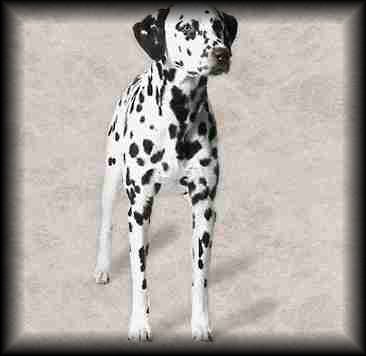
No breed has a more interesting background or a more disputed heritage than that dog from long ago, the Dalmatian. His beginnings are buried so deep in the past that researchers cannot agree as to his origin. Regarding the great age of the breed, and the fact that it has come through many centuries unchanged, investigators are in complete agreement.
Models, engravings, paintings, and writings of antiquity have been used with fair excuse but no certainty to claim the spotted dog first appeared in Europe, Asia, and Africa. Perhaps some of the divergencies in opinion as to the original home of the Dalmatian can be accounted for by the fact that the dog has frequently been found in bands of Romanies, and that like his gypsy masters, he has been well known but not located definitely in any one place. Authoritative writers place him first as a positive entry in Dalmatia, a region in west Yugoslavia along the Adriatic, which had once (1815 to 1919) been a province of Austria. Though he has been credited with a dozen nationalities and has as many native names--the English have nicknamed him the English Coach Dog, the Carriage Dog, the Plum Pudding Dog, the Fire House Dog, and the Spotted Dick--it is from his first proven home that he takes his correct name, the Dalmatian. We find references to him as a Dalmatian in the middle 18th century. There is no question whatsoever that his lineage is as ancient, and his record as straight, as that of other breeds.
His activities have been as varied as his reputed ancestors. He has been a dog of war, a sentinel on the borders of Dalmatia and Croatia. He has been employed as a draught dog, and as a shepherd. He is excellent on rats and vermin. He is well-known for his heroic performances as a fire-apparatus follower and as a fire house mascot. As a sporting dog he has been used as a bird dog, a trail hound, a retriever, and in packs for boar and stag hunting. His retentive memory has made him one of the most dependable performers in circuses and on the stage. Down through the years, his intelligence and ready willingness have qualified him for virtually every role that useful dogs are called upon to perform.
But most important among his talents has been his status as the original, one and only coaching dog. The imaginative might say that his coaching days go back to an engraving of a spotted dog following an Egyptian chariot. Even the practical minded will find no end of proof, centuries old, of the Dalmatian with ears entirely cropped away and padlocked brass collar, plying his natural trade as follower and guardian of the horse-drawn vehicle.
He is physically fitted for road work. In his make-up, speed and endurance are blended to a nicety. His gait has beauty of motion and swiftness, and he has the strength, vitality, and fortitude to keep going gaily till the journey's end. The instinct for coaching is bred in him, born in him, and trained in him through the years. The Dalmatian takes to a horse as a horse takes to him, and that is to say like a duck to water. He may work in the old way, clearing the path before the Tally Ho with dignity and determination, or following on with his ermine spottings in full view to add distinction to an equipage. He may coach under the rear axle, the front axle, or, most difficult of all, under the pole between the leaders and the wheelers. Wherever he works, it is with the love of the game in his heart and with the skill which has won him the title of the only recognized carriage dog in the world. His penchant for working is his most renowned characteristic, but it in no way approaches his capacity for friendship.
There is no dog more picturesque than this spotted fellow with his slick white coat gaily decorated with clearly defined round spots of jet black, or, in the liver variety, deep brown. He does not look like any other breed, for his markings are peculiarly his own. He is strong-bodied, clean-cut, colorful, and distinctive. His flashy spottings are the culmination of ages of careful breeding.
His aristocratic bearing does not belie him, for the Dalmatian is first of all a gentleman. He is a quiet chap, and the ideal guard dog, distinguishing nicely between barkings for fun or with purpose. His courtesy never fails with approved visitors, but his protective instinct is highly developed and he has the courage to defend. As a watchdog he is sensible and dependable. He is not everyone's dog--no casual admirer will break his polite reserve, for he has a fine sense of distinction as to whom he belongs. Fashion has not distorted the Dalmatian. He is born pure white, develops quickly and requires no cropping, docking, stripping, or artifices of any sort. He is all ready for sport or the show ring just as nature made him. He is extremely hardy, an easy keeper, suited to any climate. He requires only the minimum of care, for he is sturdy and neat and clean.