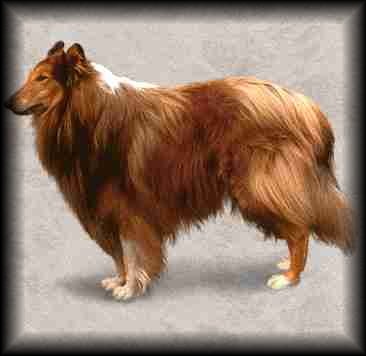
There are two varieties of Collie, the rough-coated being by far the more familiar. However, many fanciers have increased their breeding of the smooth-coated variety, and many smooths of excellent type are now being exhibited.
Although the exact origin of the Collie remains an enigma, both varieties existed long ago in the unwritten history of the herding dogs of Scotland and northern England.
Since sheepherding is one of the world's oldest occupations, the Collie's ancestors date far back in the history of dogs. The smooth Collie, which for as long as there have been written standards for the breed has been bred to the same standard except for coat, was considered principally as a drover's dog used for guiding cows and sheep to market, not for standing over and guarding them at pasture. Until the last two centuries, both varieties were strictly working dogs without written pedigrees. Their untutored masters saw no need for pedigrees, if indeed they were capable of keeping stud books.
The earliest illustrations known to bear a resemblance to both varieties are found as woodcuts in The History of Quadrupeds by Thomas Bewick, antedating 1800. The rough dog was described as a "Shepherd's Dog" and the smooth as a "ban dog." The rough was described as being only 14 inches at the shoulder and the smooth was said to be much larger and descended from the Mastiff. (Mastiff in this sense does not refer to the breed we know today by that name but was something of a generic term used basically to describe a common type of dog.) It is well established that the roughs at that time were not only much smaller but had shorter, broader heads and were usually black or black and white in color.
From early in the 19th century, when some dog fanciers began to take interest in these dogs and the keeping of written pedigrees began, the breed progressed rapidly, becoming not only larger in stature but also more refined. The dog "Old Cockie" was born in 1867 and he is credited with not only stamping characteristic type on the rough Collie but he is believed by usually reliable authorities to be responsible for introducing to the breed the factors which led to the development of the sable coat color in the Collie. A short time later Collies were seen of almost every imaginable color, including red, buff, mottle of various shades and a few sables. At that time the most frequently seen colors were black, tan and white, black and white (without tan) and what are now called blue merles, but which were known then as "tortoise shell."
The early pedigrees were very much abbreviated, as compared with our present breed records. In fact, the first volume of the English stud book showed 78 "sheep dogs and Scotch Collies" registered up to 1874. Fifteen of them had written pedigrees but only three extended beyond sire and dam. Proof that pride of ownership was given priority over written records is found in the fact that it was in 1860 that the first classes for "Scotch Sheep Dogs" were offered at the second dog show ever held in England, that of the Birmingham Dog Society. Both varieties competed in the same classes.
Shortly thereafter, Queen Victoria visited Balmoral and saw her first Collies. They captivated her and she enthusiastically began to sponsor them. There was a marked surge in the popularity of the breed which found itself not only the indispensable helpmate of the humble shepherd but the treasure and the playmate of the royal and the rich.
Collie type was well enough "fixed" by 1886 so that the English breeders have never seen fit to change the height and weight established in their standard at that time. Numerous clarifying changes have taken place in the United States standard over the ensuing years but except for recognizing that the Collie has become slightly larger and heavier on this side of the Atlantic there is no fundamental difference, even today, from that 1886 description of the ideal Collie.
Many of the early settlers in the new world brought dogs with them to herd their sheep and cattle in the Colonies, but it was not until May of 1877, 17 years after their show ring debut in England, that they were shown here, at the second show of the Westminster Kennel Club in New York. Classes were offered for "Shepherd Dogs, or Collie Dogs" and a few were entered. The next year, however, would see great interest and excitement. Two Collies imported from Queen Victoria's Royal Balmoral Kennel had been entered! Soon Collies were to be found as prized possessions of the wealthy and socially elite. Kennels were established by the well-known fancier J. P. Morgan and his financial contemporaries, and many fashionable estates up the Hudson river and on Long Island had Collie kennels. English dogs were imported for what were then considered to be exorbitant prices. It is interesting to note that about a half century later almost the reverse situation was occurring. The Collie became a highly desired breed in Japan and there was great persuasion to convince some of the American breeders to export some of their top dogs. By this time, the importation of Collies from England had become exceedingly rare.
Being no longer in great demand as a herder, today's Collie has transferred these abilities to serving as a devoted family dog where he shows a particular affinity for small children. For many years his general popularity has placed him among the top twenty of the favorite dogs registered by the American Kennel Club. Elegant and beautiful in appearance, loyal and affectionate in all his actions, self-appointed guardian of everything he can see or hear, the Collie represents, to his many admirers, the ideal family companion.
The Collie has been the beneficiary of a "good press." Its parent club, The Collie Club of America, Inc., was organized in 1886, two years after the establishment of the American Kennel Club and was the second parent club to join the AKC. Very active in promoting the interest of the breed, the parent club now has a membership numbering well over 3500 and its annual specialty show attracts over 400 Collies from all over the United States. Great impetus to the breed's popularity was provided by the famous Collie stories of Albert Payson Terhune. His "Lad: A Dog" was followed by many more volumes that have been eagerly read by several generations of Americans. More recently the television exploits of "Lassie" brought to children and their parents a strong desire to have for their very own "a lovely dog like that."