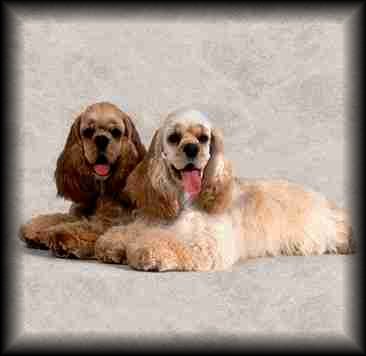
The Spaniel family is a large one, of considerable antiquity. As far back as 1368 we find mention of the Spanyell, which came to be divided into two groups, the land spaniel and the water spaniel. A further division separated the land spaniels on a basis of size, when the "cockers" and the very small or toy spaniels were separated from spaniels of larger dimensions. Then, as the cockers and the toys were used for markedly different purposes, these two were once more divided. The toys eventually became the English Toy Spaniels which were maintained principally as pets or comforters, while the Cockers retained their early classification as sporting dogs. That is why the Cocker is called the smallest member of the sporting-dog family.
As a valued helpmeet to the huntsman, this dog was known in his early days by various names, among them "cocker," "cocking spaniel," and finally Cocker Spaniel, the name deriving, according to some authorities, from especial proficiency on woodcock. Not until 1883 were classes provided for him at English bench shows; and not until 1892 was he given breed status in England's Kennel Club stud book.
The Cocker has been exhibited in the United States since the early 1880s. As developed here, however, the American Cocker has evolved somewhat differently in type, size, and coloring from the breed now recognized as the English Cocker Spaniel.
Field trials for the breed in this country were started by the Cocker Spaniel Field Trial Club in 1924. The Cocker's inherent desire to hunt renders him a capable gun dog when judiciously trained. The usual method of hunting is to let him quarter the ground ahead of the gun, covering all territory within gun range. This he should do at a fast snappy pace. Upon flushing the game he should stop or preferably drop to a sitting position so as not to interfere with the shot, after which he should retrieve on command only. He should, of course, be so trained that he will be under control at all times. He is likewise valuable for occasional water retrieving and as a rule takes to water readily.
Many of the qualities that make it a valued hunter have served to make it a highly treasured companion for the home. Almost from the moment it appeared in the show rings, the Cocker achieved great popularity. Energetic, readily trainable, intelligent, affectionate and--as their constantly wagging tails tell us--quite merry, the handsome Cocker is today one of America's favorite pure-breds, No. 2 in AKC registrations.