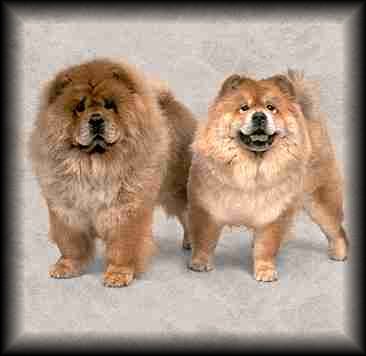
Due in great measure to the ruthlessness with which Chinese emperors destroyed the works of art and the literature of their predecessors, it is difficult to secure evidence of the antiquity of that lordly, aloof dog, the Chow Chow. Still, a bas-relief was discovered not so very long ago that dates back to the Han dynasty, about 150 B.C., which definitely places the Chow as a hunting dog during that period. While this establishes the breed as more than 2000 years old, it is believed by many authorities that the Chow goes back much farther; that it is, indeed, one of the oldest recognizable types of dog.
The theory has been advanced that the Chow originated through crossing the old Mastiff of Tibet and the Samoyed, from the northern parts of Siberia. Certainly the Chow evinces some of the characteristics of both breeds. Refutation lies in the fact that the Chow possesses a blue-black tongue. On this score, some maintain that the Chow is one of the basic breeds, and that he may have been one of the ancestors of the Samoyed, the Norwegian Elkhound, the Keeshond, and the Pomeranian, all of which are of somewhat similar type.
In modern times the Chow Chow has become a fashionable pet and guard dog, but there is plenty of evidence available in China to prove that for centuries he was the principal sporting dog. Perhaps the most unusual and lavish kennel in all history was the one maintained by a T'ang emperor in about the 7th century A.D. It was so extensive that the emperor could not have availed himself of a fraction of the facilities for sport it afforded. It housed 2500 couples of "hounds" of the Chow type, and the emperor had a staff of 10,000 huntsmen.
Apparently the Chow has been an unusually gifted breed of dog, since his uses have run the gamut of work done by nearly all recognized breeds. Credited with great scenting powers, with staunchness on point, and with cleverness in hunting tactics, he has been used frequently on Mongolian pheasant, and on the francolin of Yunnan, and on both has received great praise for his speed and stamina.
Undoubtedly the Chow Chow is of far northern origin, but he has always been found in greatest number in the south of China, particularly in the district centering about Canton. In that region of China where he is considered indigenous, he is usually called the "black-tongued" or the "black-mouthed" dog. In the north, as in Peking, he is called lang kou (wolf dog), hsiung kou (bear dog) or the more sophisticated hei she-t'ou (black tongued) or Kwantung Kou, i.e., the dog of Canton.
The name Chow Chow has little basis for its origin in China; it is believed that expression evolved from the pidgin-English term for articles brought from any part of the Oriental empire during the latter part of the 18th century. It meant knickknacks or bric-a-brac, including curios such as porcelain and ivory figurines, and finally what is described today as "mixed pickles," whether of the edible variety or not. It was far easier for the master of a sailing vessel to write "chow chow" than it was to describe all the various items of his cargo. So, in time, the expression came to include the dog.
The first Occidental description of the Chow Chow was penned by the Reverend Gilbert White, rector of Selborne, England, and this was published later in the Natural History and Antiquities of Selbourne. The description, which is a most complete one, indicates that the dogs were not very different from specimens of modern times. It was a neighbor of the rector who in 1780 brought a brace of Chows from Canton on a vessel of the East India Company.
The importation of Chows into England did not begin, however, until about 1880, and the breed started toward its present popularity after Queen Victoria took an interest in it. The first specialty club was formed in England in 1895. The dog was exhibited for the first time in the United States in 1890 when a specimen named Takya, and identified as a Chinese Chow Chow owned by Miss A. C. Derby, took a third prize in the Miscellaneous Class at the Westminster Kennel Club show in New York.
The AKC officially recognized the breed in 1903. The Chow Chow Club of America was admitted as an AKC member club in 1906. Today, it is one of America's firmly established breeds.