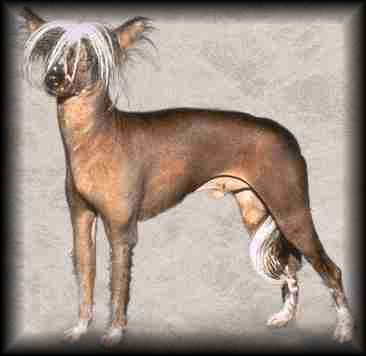
Although the exact origin of the Chinese Crested is unknown, it is believed to have evolved from African hairless dogs which were reduced in size by the Chinese, who seemed to like smaller Toy breeds. The breed in earlier times was known by several different names including the Chinese Hairless, the Chinese Edible Dog, the Chinese Ship Dog, and the Chinese Royal Hairless. It also took on local nicknames depending on where it was found. Thus, in Egypt it was called a Pyramid or Giza Hairless, in southern Africa it was the South African Hairless, and in Turkey a larger version was known as the Turkish Hairless.
It is believed that for centuries Chinese sailors sailed the high seas with the breed on board, and that puppies were frequently traded with local merchants at port cities. It is known that during the time of the plagues that originated in China, hairless dogs were stowed on board ships to hunt vermin which were heavily infested with fleas carrying the disease. Today the breed can still be found in ancient port cities around the world.
Spanish explorers found Chinese Crested dogs in Mexico and other parts of Central and South America as early as the 1500s. British, French and Portuguese explorers likewise found the breed in various parts of Africa and Asia during the 1700s and 1800s. The diaries of early missionaries, who frequently traveled with the explorers, describe finding the breed in many of these countries.
By the mid-19th century, Cresteds began to appear in numerous European paintings and prints. During the 1850s and 1860s, some dogs of the breed were exhibited at a local zoological show in England, and photos of them were published, but no breeding program was established.
Entries of the breed at American dog shows began in the late 1800s. In the 1800s, Ida Garrett, a young, New York newspaperwoman, became interested in Cresteds and other hairless breeds. Over the course of 60 years Mrs. Garrett bred, exhibited, and wrote extensively about dogs--hairless breeds in particular. She traveled widely and imported several prized Cresteds. In the 1920s she assisted Debra Woods of Homestead, Florida in obtaining Chinese Cresteds and other hairless breeds, and the two women became close associates. For nearly 40 years they jointly promoted the Chinese Crested--Mrs. Garrett through her prolific writing, speaking, and dog club activities, and Mrs. Woods through her extensive breeding, advertising, and registration service.
Mrs. Woods began keeping a lot of all of her dogs in the 1930s and by the 1950s it had become a registration service for all hairless breeds, and eventually the American Hairless Dog Club. She took great pride in maintaining these stud books and closely guarded them until her death in 1969. They were then maintained for nearly 12 years by Jo Ann Orlik and then became the property of the American Chinese Crested Club, founded in 1979.
Gypsy Rose Lee, the famous stage personality, acquired a Crested from her sister, June Havoc, in the early 1950s and became an ardent breeder and helped considerably in publicizing the breed.
The Chinese Crested was admitted to the AKC Miscellaneous class in September 1985. It became eligible for AKC registration effective February 1, 1991, and eligible to show at AKC licensed events on April 1, 1991.
At first sight the two types of Chinese Crested--Hairless and Powderpuff--may appear to be different breeds. However, as one becomes more familiar with the breed it is easy to see that they are almost exactly the same, except that the coated have more hair. The Hairless should have hair on its head, feet and tail--the Powderpuff is born fully coated. Breeding a Hairless to a Hairless, or a Hairless to a Powderpuff, can produce either type. However, breeding a Powderpuff to a Powderpuff will always produce the Powderpuff type.
A unique feature of hairless dogs is that they have sweat glands. Rather than panting to release body heat as coated dogs do, they simply sweat. Properly cared for, the skin of the Hairless remains soft to the touch, yet it is thicker and tougher than that of a coated dog and it heals very quickly if scratched or cut.