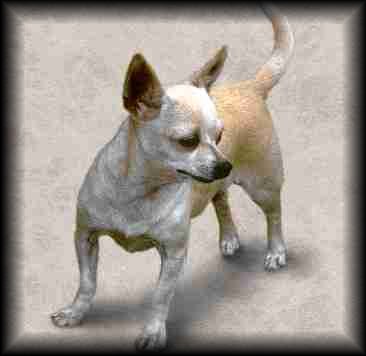
While little or nothing is known of the previous history of the Toltecs, it has been established that they existed in what is now Mexico as early as the 9th century A.D., and that during their several centuries of occupancy they had a breed of dog called the Techichi. This dog was small, although not tiny, and of heavy-boned structure. His coat was long, while his most distinctive feature was muteness.
The Techichi, regarded as indigenous to Central America, is the progenitor of the Chihuahua that now enjoys popularity throughout the United States, where he has been bred to his greatest perfection. No records of the Techichi are, so far, available prior to the 9th century, but it seems probable that his ancestors were in the locality prior to the advent of the Maya tribes in about the 5th century.
The evidence firmly establishing the Techichi to the Toltec period is found in pictures carved on stones--they may be found today in the Monastery of Huejotzingo, on the highway from Mexico City to Puebla. This monastery was constructed by the Franciscan Monks around 1530 from materials of the existing Pyramids of Cholula, built by the Toltecs. The carvings give a full-head view and a picture of an entire dog that closely approximates the Chihuahua of modern times. There are also remains of pyramidal type constructions and some pointers to the early existence of the Techichi at Chichen Itza in the distant Yucatan.
Toltec civilization was centered principally around Tula, which is close to the present Mexico City, and there one finds the most abundant relics of the ancient breed. For that reason, there has always been speculation regarding the discovery of the earliest specimens of the modern breed in the State of Chihuahua. The dogs were found, about 1850, in some old ruins close to Casas Grandes, said to be the remains of a palace built by Emperor Montezuma I.
The conclusions of K. de Blinde, a Mexican breeder and authority who spent years traversing sections of the country on horseback, were that the present form of Chihuahua evolved from crossing the Techichi with the small hairless dog brought from Asia to Alaska over the land bridge where the Bering Strait now runs. This hairless dog, similar to the one found in China, was responsible for the reduction in size.
The Aztec conquerors of the Toltecs flourished for several centuries, and just prior to the coming of Hernando Cortes civilization was at a high state and the wealth was prodigious. Dogs of the rich were highly regarded, and the blue-colored ones were held as sacred. Paradoxical as it seems, the common people found little use for this breed, and there are even tales that they were eaten.
The stormlike career of Cortes in Mexico during 1519-20 left little of either Aztec wealth or civilization. Practically all Montezuma's possessions were wrung from his dying hands, and it is only natural that his dogs became lost for several centuries.
While the Techichi's principal home was Mexico, there is a historic letter written by Christopher Columbus to the King of Spain that adds a curious note to knowledge of the breed. Reporting on the seizure of the present island of Cuba, Columbus stated that he found: "A small kind of dogs, which were mute and did not bark, as usual, but were domesticated." These dogs could not have been taken to Cuba by the Aztecs, who were not a seafaring people.
Legend and history are rich in tales of the ancestors of the present Chihuahua. He is described as a popular pet, as well as a religious necessity among the ancient Toltec tribes and later among the Aztecs. Archaeologists have discovered remains of this breed in human graves in Mexico and in parts of the United States.
The phenomenon is believed due to the part the dog played in the religious and mythological life of the Aztecs. He was employed in connection with the worship of deities, with the voyage of the soul in the underworld, and in relation to the human body. With the sacrifice of a dog with a red skin, burning it to ashes with the corpse of the deceased, the sins of the human were supposed to be transferred to the dog, and the indignation of the deity thus averted. The dog also was credited with guiding the human soul through the dark regions of the underworld, fighting off evil spirits and leading the soul of the deceased safely to its ultimate destination.
The modern Chihuahua is quite different from his early ancestors, with his variegated colors ranging from snow white to jet black. Mexico favors the jet black with tan markings, and the black and white spotted. The United States prefers the solid colors.
American breeders have produced a diminutive dog that has few comparisons, even among other breeds, in size, symmetry, and conformation, as well as intelligence and alertness. Curiously, the Chihuahua is clannish, recognizing and preferring his own kind, and, as a rule, not liking dogs of other breeds. The smooth-coated are the most numerous in the United States, and the most clannish, but the long- coated Chihuahua is rapidly increasing. It has all the characteristics of the smooth.