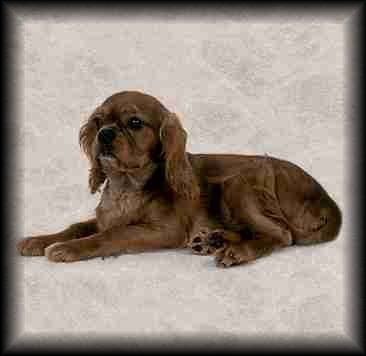
The Cavalier King Charles Spaniel, or Cavalier as the breed is commonly called, enjoys the unique distinction of being the only purebred dog born of dissatisfaction. In short, he is a renovated English Toy Spaniel forced by modern selective breeding to take on once again the characteristics which distinguished him in his earlier days.
One Roswell Eldridge of Long Island, New York, a breeder of English Toy Spaniels of the Blenheim variety, early in the century went abroad to look over the current crop of his favorites as then existing in the English show ring. To his dismay, he found that they differed radically from the dogs depicted in the paintings of 16th, 17th and 18th century artists. They were exaggerated in the globular contour of the head, in the pronounced dome of the topskull, and the almost noseless foreface. Furthermore, they were too small for his taste. Van Dyck and others of like fame had painted the Toy Spaniel as more nearly flat in skull, rather shallow in stop indentation, and quite a bit longer in nose. These were among the characteristics Mr. Eldridge considered typical, so he set out without delay to do something about it.
With an astuteness based upon his experience as a breeder, he went right into the show room to correct the wrong that in his estimation had been done by fanciers of the Victorian era, and in so doing he sparked the creation of a different breed. In the year 1926 he offered cash prizes at England's famous Crufts show for Blenheim Spaniels of the old type; prizes that ran for a five-year period. The rank and file breeders were astounded at what they considered a flagrantly backward step. There were a few, however, who shared Mr. Eldridge's dissatisfaction with the modern trend of the English Toy Spaniel, and these few then and there determined to produce somewhat larger specimens which would resemble more closely the old-time dogs. They lost no time in getting started, and in 1928 they formed a club for the advancement of their new breed. Naturally, their initial efforts were discouraging but before very long results began to show.
Selective breeding is a long protracted process requiring some 50 years to bring about radical changes. But in less than half that time, the Cavalier was on his way toward standardization because the characteristics sought for him had been lying low, as it were, all through the years. They had not been wholly obliterated.
The Spaniels of the House of Marlborough, for instance, in the 1800s, were of three kinds: small sized Cockers, larger sized specimens which eventually became Springers, and Toy sized red and whites endowed with the hunting spaniel head as opposed to the ultra short foreface. The Marlborough Spaniels at Blenheim were nowhere exaggerated. Imbedded within them were the very qualities which creators of the Cavalier needed to style their dog; qualities which kept cropping up from time to time in the usual course of English Toy Spaniel breeding only to be discarded as undesirable. So the Cavalier breeders took the dogs with noses, flat skulls, shallow stops and larger size, bred from them consistently and in a comparatively few years they turned back time and got the dog more as they wanted him. Meantime, the going was hard. The dogs did not sell and oftentimes had to be given away because the public was not educated to them. Finally, however, the new breed took on. The Kennel Club, England, admitted it to registry in 1944, and it is presently eliciting considerable interest in the United States.