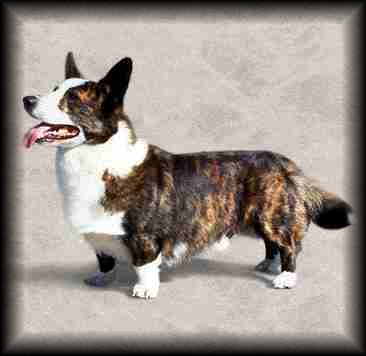
The Cardigan Welsh Corgi, the Corgi with the tail, is the older of the two Corgi breeds, and one of the earliest breeds in the British Isles.
(The data upon which this summarized history is written was collected over a period of twenty years by W. Lloyd-Thomas of Mabws Hall, Llanrhystyd, Cardiganshire, South Wales.)
In the beginning, the Corgi came to the high country now known as Cardiganshire along with the tall, tawny-headed Celts from Central Europe. The migration of this warrior tribe to Wales is placed, roughly, at about 1200 B.C., which means that the Corgi has been known in the land whence its name comes for more than 3000 years. The dog was a member of the same family that has produced the Dachshund.
The bustling village of Bronant in Mid-Cardiganshire became the especial stronghold of those early Celts. The vigilance and intelligence of the Corgi must have been great assets to the Celts, and tales handed down from father to son for generations identify him always as a valued member of the family circle. His uses were many and varied, not the least of which were his guardianship of the children and his aid in beating out game, which in those times was of more than ordinary importance.
The occupation which made the Corgi worth his weight in gold to those Welsh hillmen came at a much later period, but still hundreds of years ago. This was when the Crown owned practically all land, and the tenant farmers, or crofters, were permitted to fence off only a few acres surrounding their dooryards. The rest was open country, known as common land, on which the crofter was permitted to graze his cattle, one of the chief sources of his meager income. It can be imagined that there was great competition among the crofters to secure as much as possible of this pasture land for their own uses, and the task would have been difficult had it not been for the Corgi. The little dog, which had been with these Celtic people so long and which had come to possess an almost human intelligence, was trained to perform a service the opposite of that performed by the herding dog.
Instead of herding cattle, the Corgi would nip at their heels and drive them as far afield as desired. Often the crofter called upon his dog to clear "his" ground of the neighbor's cattle. The dog worked the same way in either case. The crofter would stand by his gate and give a soft whistle of two notes, one high, one low. Many times the dog could not see the cattle he was to chase, but he would keep going as long as he could hear that whistle. His speed was remarkable, considering his short legs with their out-turned feet, but the length of his back gave him added spring. When the dog had scattered the cattle by biting their hocks--avoiding death only by ducking close to the ground when they kicked--the crofter would the give the recall signal, a shrill, long-drawn-out whistle made by placing the fingers in the mouth. The dog would return at once.
The division of the Crown lands, their subsequent sale to the crofters, and the appearance of fences lessened the usefulness of the Corgi. He was still retained as guard and companion by some of the hillmen, but to most he was a luxury they could not afford. In many instances he was succeeded by the red herder and by the brindle herder. The original type of Corgi known in Bronant since time immemorial became very scarce, and it is due only to the greatest care on the part of modern breeders that the old strains have been preserved.
Needless to say, stud books were unknown to the Celts and to the early Welsh farmer-descendants of the old warrior tribe. But if there were no records, there was a rigid policy of selective breeding unsurpassed in this present day. The original Corgis had to be proficient workers, and no mating was consummated without due consideration.
After the breaking up of the Crown lands, and the introduction of the new breeds, there was a certain amount of experimentation with crosses. The ancient dog of Bronant was crossed with the red herder, but it did not prove very successful and was not attempted many times. The brindle herder, however, made a rather fortuitous cross. The progeny followed the dominant characteristics of the Corgi, and gained a little through the finer coat and the color of the brindle herder. Crossed later with the Collie, there was produced the breed known as the heeler.
The principal strains of the Cardigan Welsh Corgi of today go back to the old Bronant Corgi with a slight infusion of brindle herder blood. This dog approximates as nearly as possible the dog that enjoyed his greatest popularity in Cardiganshire a century and more ago.
The two Corgi breeds were regarded officially in England as one breed divided into two types until 1934, when they were recognized as separate breeds. Up until that time they had been interbred to some extent, and sorting out the two breeds became a difficult task. In 1934, 250 Pembrokes were registered to only 59 Cardigans. The Cardigan was considered to be less uniform in type at that time and the breed nearly disappeared in its native Wales.
The first pair of Cardigans imported to the United States (by Mrs. Robert Bole of Boston) arrived in June, 1931. The breed was admitted for AKC registration in 1935.