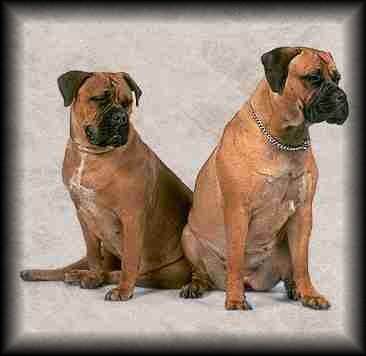
The known history of the Bullmastiff begins about the year 1860 in England. It is probable that the story of the breed is really centuries old, but proof is difficult.
Toward the end of the 19th century in England, the problem of keeping large estates and game preserves free from the depredations of poachers was an acute one. Penalties were severe, yet poaching seemed impossible to eradicate by mere laws. Accordingly, the gamekeeper's life was anything but safe. Poachers would often prefer to shoot it out with the keeper on the chance of escape rather than accept the penalties which they would incur upon apprehension.
It is not surprising, therefore, that the gamekeepers decided to enlist the aid of the greatest protector nature has given to man--the dog. These men cared nothing for the looks of a dog as long as he served them well. Numerous breeds were therefore tried. The Mastiff, while courageous and powerful, was not fast enough and not sufficiently aggressive. The Bulldog, big, strong and active in those days, was a trifle too ferocious and not large enough for their needs. These men wanted dogs that would remain silent at the approach of poachers. They needed fearless dogs that would attack on command. They wanted the poachers thrown and held, but not mauled. For these needs, they crossed Mastiff and Bulldog, and from this utilitarian birth, the Bullmastiff was founded.
Inevitably, came the rivalry between keepers as to the quality of their dogs. Inevitably, also, came the breeding to and from outstanding performers of their time--a true survival of the fittest. For many years, then, after the birth of the breed, its history was wholly a utilitarian one. The only contests in which the Bullmastiffs engaged were against man, either on the moor or in demonstrations. In those days the Bullmastiff was known sometimes by his present name, but more often as the "Gamekeeper's Night-Dog."
During the breed's early years, we find interesting references by contemporary writers. One appears in the book Dog Breaking, published in 1885:
"Bulldogs have good noses. I have known of the cross between them and the Mastiff being taught to follow the scent of a man almost as truly as a Bloodhound."
In The Field, August 20, 1901, we find the following:
. . . Mr. Burton of Thorneywood Kennels brought to the show one Night-Dog (not for competition) and offered any person one pound who could escape from it while securely muzzled. One of the spectators who had had experience with dogs volunteered and amused a large assembly of sportsmen and keepers who had gathered there. The man was given a long start and the muzzled dog slipped after him. The animal caught him immediately and knocked down this man the first spring. The latter bravely tried to hold his own, but was floored every time he got on his feet, ultimately being kept to the ground until the owner of the dog released him. The man had three rounds with the powerful canine, but was beaten each time and was unable to escape. . .
For this type of work, dogs of a dark brindle color were preferred owing to their lack of visibility. It was inevitable, however, that as the breed gained in popularity and true Mastiff blood was used, a large number of light fawns should appear. With the gradual disappearance of poaching and the continued demand for Bullmastiffs as guards and watchdogs, this color became popular. The black mask and densely colored ears were often inherited from the Mastiff.
Finally, owing to the increasing popularity of the breed, a number of pioneers started, on a scientific basis, to breed to type in an effort to set a goal which pure-bred dog breeders might seek. This type finally became sufficiently distinct for the English Kennel Club to grant recognition of the Bullmastiff as a pure-bred dog in 1924. At this time the Kennel Club differentiated between the Bullmastiff, crossbred, and the Bullmastiff, pure-bred, the latter being, of necessity, the descendant of three generations of dogs which were neither pure Mastiff nor pure Bulldog. Classes were then provided at a few shows and the dogs were finally awarded Challenge Certificates in 1928. In time the breed became known in many countries, having been exported from England to Siam, India, the Federated Malay States, Africa, and America. The short coat has proved convenient in warm climates, and yet the dog can live in the open in inclement weather.
The American Kennel Club granted recognition to the Bullmastiff in October, 1933 and since that time the breed has made numerous friends in this country.