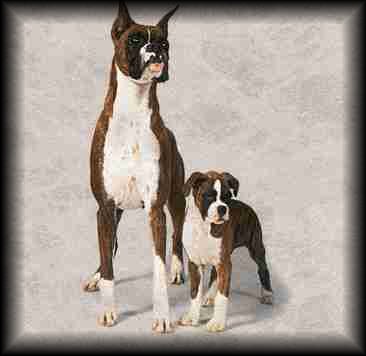
Although it has reached its greatest perfection in Germany during the past hundred years, the Boxer springs from a line of dogs known throughout the whole of Europe since the 16th century. Prior to that time, ancestors of the breed would hardly be recognized as Boxers could they be placed beside modern specimens. Still, evidence points to the Boxer as one of the many descendants of the old fighting dog of the high valleys of Tibet.
The Boxer is cousin to practically all recognized breeds of the Bulldog type, and these all go back to basic Molossus blood. Few other strains can claim such courage and stamina; and from this line emanates the attractive fawn color that has recurred throughout the centuries.
Flemish tapestries of the 16th and 17th centuries show scenes of stag and boar hunting; the dogs are the same as the Spanish Alano, found in great numbers in Andalusia and Estramadura, and the Matin de Terceira or Perro do Presa, from the Azores. The Alano and the Matin have been regarded as the same breed--they are either ancestors of the Boxer or they trace back to a common ancestor.
In France, there is a breed known as the Dogue de Bordeaux that is very close, both in appearance and size to the old Tibetan Mastiff, and it is from this massive dog that the Bouldogue de Mida was developed. The Bouldogue du Mida, found principally in the south of France, possesses many of the points of the Boxer.
While all the European breeds mentioned are related to the Boxer, this favorite of Germany has been developed along scientific lines that not only have succeeded in retaining all his old qualities, but have resulted in a much more attractive appearance. Besides Bulldog blood, the Boxer carries a certain heritage from a terrier strain. There is also some reason to believe that English Bulldogs were at one time imported into Germany. Indeed, Reinagle's noted Bulldog, done in 1803, is not unlike the Boxer, and pictures of some English specimens of 1850 are almost identical with the German dog.
Until dogfighting and bullbaiting were outlawed by most civilized peoples in the middle of the 19th century, the Boxer, like all dogs of his type, was used for this purpose. Today he has become an accredited member of society, but he still has the same degree of courage and the ability to defend, a well as aggressiveness when needed. Withal, he is devoted to his master.
The quality of the Boxer is best emphasized, perhaps, when we remember that he was one of the first selected in Germany for police training. This work demands intelligence, fearlessness, agility, and strength.
Considering that the entire modern history of the Boxer is wrapped up with Germany, it seems rather curious that he bears a name obviously English. Yet the name fits him. It arises from his manner of fighting, for invariably he begins a fight with his front paws, somewhat like a man boxing.
The first AKC registration of a Boxer was in 1904, and the first championship was finished in 1915, but it was not until about 1940 that the United States public began to take a real interest in the breed. This came about because of the consistent Group and Best in Show wins scored by some outstanding Boxers.