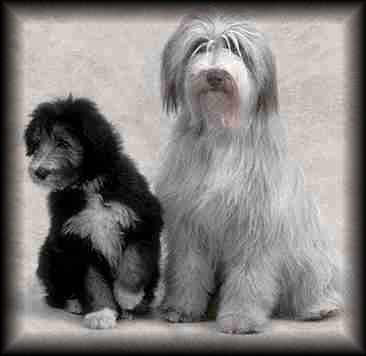
Sometimes known as the Highland Collie, the Mountain Collie, or the Hairy Mou'ed Collie, the Bearded Collie is one of Britain's oldest breeds. While some have theorized that the Beardie was around to greet the Romans when they first invaded Britain, the current theory is that like most shaggy haired herding dogs, the Bearded Collie descends from the Magyar Komondor of central Europe.
As with most breeds not used by the nobility, there are few early records on this humble herdsman's dog. The earliest known pictures of Bearded Collies are a 1771 Gainsborough portrait of the Duke of Buccleigh and a 1772 Reynolds portrait of that peer's wife and daughter accompanied by two dogs. With Reinagle's more easily recognizable "Sheepdog" published in Taplin's 1803 Sportsman's Cabinet, and a description of the breed published in an 1818 edition of Live Stock Journal, the existence of the breed as we know it is firmly established.
At the end of the Victorian era, Beardies were fairly popular in the southern part of Scotland, both as working and as show dogs. When Bearded Collie classes were offered at shows, usually in the area about Peebleshire, they were well supported. However, there was then no official standard, since no breed club existed to establish one and each judge had to adopt his own criteria. The lack of a strong breed club proved quite a misfortune. The local popularity of the breed continued until World War I, during which there were very few dog shows. By the 1930s there was no kennel breeding Bearded Collies for show purposes.
That Beardies did not die out rests on their ability as workers and the devotion of the Peebleshire shepherds and the drovers to the breed. They are still highly valued as a sheepdog, due to their ability to turn in a good day's work in south Scotland's misty, rainy and cold climate, and their adeptness on the rough, rocky ground.
The Bearded Collie's other major use is as a drover. They work with little direction from the butchers and drovers who find them very valuable in moving troublesome cattle. The shepherds and drovers have valued Beardies to such an extent that they have been more than a little reluctant to sell any puppies (especially bitches) unless they could be sure the puppies would actually be worked.
After World War II, Mrs. G. O. Willison, owner of the Bothkennar Kennels, saved the Beardie from further chance of extinction when she began to breed them for show purposes. She spearheaded the establishment of the Bearded Collie Club in Britain in 1955. After much travail, in 1959 the Kennel Club in England allowed Bearded Collies to be eligible for Challenge Certificates and championships and the popularity of the breed began to steadily increase.
Bearded Collies were introduced into the United States in the late 1950s, but none of these dogs were bred. It wasn't until 1967 that the first litter of Bearded Collies was born in this country. By July 1969, there was enough interest for the Bearded Collie Club of America to be founded.
The breed became eligible to be shown in the Miscellaneous Class as of June 1, 1974. The AKC Stud Book was opened to Bearded Collie registrations on October 1, 1976, and the breed became eligible to compete in the Working Group on February 1, 1977. It became a breed of the Herding Group when that group was established, effective January 1983.