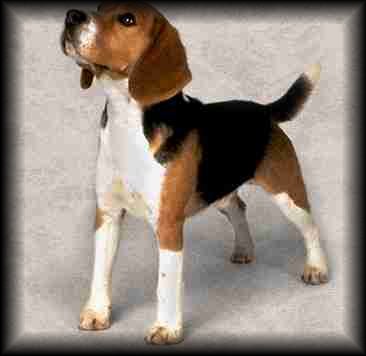
The actual origin of the Beagle is lost in the mists of ancient days and no research, it seems, can ever bring its true history to light. Several well-known Beaglers have written their opinions on the origin of the breed, and the following remarks are by Captain Otho Paget of Melton Mowbray, England, who was, perhaps, the dean of all Beaglers.
". . . According to Xenophon there were hounds that hunted by scent in his day and the Romans acquired many of the sports of ancient Greece. There were, however, in England, packs of hounds before the time of the Romans and it is on record that Pwyll, Prince of Wales, a contemporary of King Arthur, had a special breed of white hounds of great excellence. Wales, to this day is still celebrated for its hounds, generally of a light color. Admirers of shooting dogs, setters, spaniels and other kinds, have asserted that these animals were used in building up the hound. By exercise of a little thought it will seem that this must be wrong and that in fact it is the other way about. The hound was the original progenitor of all sporting dogs, and the two distinct breeds would be the "Gaze" or "Greyhound" that hunted by sight alone, and the hound, probably the Bloodhound, that relied entirely on its nose. By the time of good Queen Bess, nearly every country gentleman in England kept a pack of hounds of some sort and hunted the animal of his choice. The fox was not at that time an honored beast of the chase. Hounds in those days seem to have been divided into two classes, the large and the small. The large sort were called "Buck Hounds" and hunted the deer, and the smaller variety were called "Beagles" from the French "Begle" and were hunted on hare. . . ." .
Coming down to the middle of the 18th century, we find fox hunting becoming popular with the younger generations, who wanted something quicker and more exhilarating than watching hounds puzzling out the intricate windings of a hare. The Foxhound was undoubtedly evolved from a mixture of buck hound and Beagle. By this time the vagaries of breeders had produced two distinct types of hare-hunting hounds, one of which was called the Southern hound and the other the North Country Beagle. The former was slow and ponderous, with long ears and deep voice, while the other was the exact opposite. According to a writer of that day the "North Country Beagle" was nimble and vigorous and did his business as furiously as Jehu himself could wish him.
In the middle of the 19th century Parson Honeywood got together a good pack and showed some excellent sport in Essex. His pack dates as the beginning of the modern Beagle, and nearly every well-known pack of subsequent date owed its origin to that inheritance. We can accept it as true that the Beagle is one of the oldest breeds in history and, with the Bloodhound and perhaps the Otter Hound, closest to the original breed of hounds.
Previous to about 1870 in the United States, the little hunting hounds of the Southern States, then called Beagles, were more of the type of straight-legged Bassets or Dachshunds with weaker heads than the Bassets and were mostly white with few dark markings. They were said to be snappy, tireless hunters, full of vim and quick at a turn, but not handsome in outline. The importations of General Richard Rowett of Carlinsville, Illinois, in the 1860s marks the turning point in the history of the American strain or strains of Beagle and brought to this country an acquisition of canine beauty little thought of by those who hitherto had hunted with Beagles. From what packs in England General Rowett obtained his hounds is not known.
About 1880 Mr. Arnold of Providence, R.I., imported a pack from the Royal Rock Beagles in the North of England, and this also had a good deal of influence on the development of American Beagles. In 1896 James L. Kernochan imported a pack from England and from then on a great many high-class hounds were brought over.
In 1888 the National Beagle Club was formed and held the first field trial. From that time on field trials carrying championship points sprang up rapidly all over the United States, and as many more clubs were sanctioned to hold informal trials. At all these, packs are run in single classes for hounds 13 to 15 inches in height and classes for those under 13 inches, and at the national trials the pack classes are an important feature. There are single classes for young hounds called "derbies" and all-age classes for large and small dogs and bitches. At the national there are, in addition to these single classes, four pack classes which, of course, cannot be run against each other at the same time, as are the hounds in the single classes. Each pack is hunted separately and scored by the judges.
In addition to the regular all-breed American Kennel Club shows, almost all the field-trial clubs conduct specialty shows in connection with their field trials, and in addition to this again, there are hound shows limited to the various breeds of hounds.
Those who are interested in hunting Beagles as a pack generally enjoy hunting the larger hares, rather than cottontail rabbits. Hares do not go to ground and spoil a hunt, and they give much longer, straighter, and faster runs. The white hare, or snowshoe rabbit, is found in northern swamps and provides excellent sport for a pack, but these hares will not do well when imported to other communities and disappear immediately.
There are thousands of men all over the United States who keep a few Beagles and hunt them individually. In addition, there are many packs recorded with the National Beagle Club. They are all hunted in the legitimate manner with a regular hunt staff, in hunt liveries, with their own distinctive colored collar, etc.
The height limit of a Beagle in the United States is 15 inches and in England 15 inches. Hounds above this height cannot be entered in field trials or shows.
The soft brown eyes of the Beagle betray his warm personality but do not instantly reveal his admirable courage and stamina. The latter qualities are especially important while the Beagle is at work in the field, but in the home no gentler, more trustworthy friend could be found.