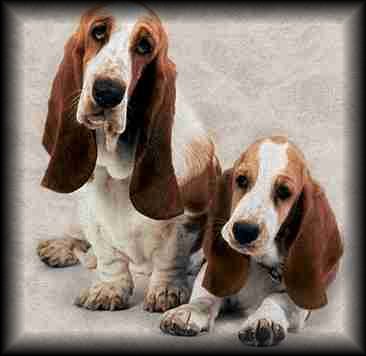
Since the 1950s the Basset Hound has emerged from relative obscurity to become one of the most publicized and characterized breeds. Actually, the Basset Hound is an old, aristocratic breed. Originally of French lineage, it has flourished for centuries in Europe, primarily in France and Belgium, where it was used chiefly for the slow trailing of rabbits, hares, deer and any other game that can be trailed on foot or taken to ground.
The foremost use of the Basset Hound in the United States is for the hunting of rabbits. However, it is possible to train them for hunting other game such as raccoons and for the trailing, flushing and retrieving of wounded pheasants and other game birds. The Basset is a sturdy, accurate trailer; his tongue is loud and distinctive. The shortness of his legs and his tight, close coat make him particularly useful in dense cover. In trailing ability, the accuracy of his nose makes him second only to the Bloodhound. His slow going ways and appealing clownish appearance belie great intelligence.
Gentle in disposition, the Basset is agreeable to hunting in packs as well as singly. Medium as to size, loyal and devoted to his master and family, not requiring extensive coat care or trimming, considered an "easy keeper"--all makes the Basset an ideal family pet and housedog.
The first mention of the word "Basset" as applied to a breed of dog appears to have been in an early text on hunting written by Fouilloux in 1586. This book is illustrated with what is considered the first drawing of a Basset, a woodcut showing a sportsman going out in his charette de chasse accompanied by his "badger dogs" and Fouilloux gives advice on training the dogs for the purpose of badger hunting.
It is thought that the friars of the French Abbey of St. Hubert were instrumental in selective breeding from various other strains of French Hounds to produce a lower set, hence slower moving dog which could be followed on foot. The word "Basset," derived from the French adjective bas, means a "low thing" or "a dwarf." Since hunting was a classic sport in medieval france, it is not surprising that many of the thoroughly efficient small hounds found their way into the kennels of the aristocracy, only to be dispersed with the changing life style brought on by the Revolution. However, the breed was not lost and we find them mentioned again by M. Blaze in his sporting book Le Chasseur, written in 1850. About the same time, in his book Chiens de Chasse, M. Robert writes:
"The Basset will hunt all animals, even boar and wolf, but he is especially excellent for the chasse a tir (shooting with the aid of hounds) of rabbits and hares."
By the mid-19th century, the two largest breeders of Bassets in France were producing dogs of slightly different type, especially in head and eye, the two types being identified by the names of their respective breeders. M. Lane's hounds were broader of skull, shorter of ear and with a rounder and more prominent eye. They were generally lemon and white in marking and had a tendency to knuckling. Count Le Couteulx produced hounds that had more narrow heads, more doming in topskull, a softer, more sunken eye with prominent jaw and a down-faced look that created more facial expression. The more glamorous tricolors of the Le Couteulx hounds made them preferred.
In 1886 Lord Galway imported a pair of French Bassets of the Le Couteulx type to England. The following year a mating of these two produced a litter of five pups, but as there was no public exposure of them, no interest in the breed was stirred. It was not until 1874 when Sir Everett Millais imported from France the hound, Model, that real activity with the breed began in England. For his support of the breed and continued drive on a breeding program within his own kennel as well as cooperation with breeding programs established by Lord Onslow and George Krehl, Sir Everett Millais has to be considered the "father of the breed" in England. He first exhibited a Basset at an English dog show in 1875, but it was not until he helped make up a large entry for the Wolverhampton show in 1880 that a great deal of public attention was drawn to the breed. A few years later interest was created when Queen Alexandra kept Basset Hounds in the royal kennels.
In the United States it is thought that George Washington was the owner of Basset Hounds presented to him as a gift by Lafayette after the American Revolution. In 1883 and 1884 English importations were made by American fanciers of the breed. In 1884 Westminster Kennel Club held a class for the Basset Hound and the English import, Nemours, made his debut before the American public. After subsequent entries at Eastern shows, he completed his championship at Boston in 1886. The first Basset Hounds were registered with the American Kennel Club in 1885.
Gradually the breed began to find favor. By the 1920s Gerald Livingston was making multiple importations for his Kilsyth Kennels on Long Island. About the same time Erastus Tefft brought over to his kennels a number of English Bassets, drawing heavily from the Walhampton Pack. Carl Smith imported two French Bassets, one a French champion. Bassets were beginning to be represented regularly at larger shows.
Further attention was drawn to the breed when the February 27, 1928 issue of Time magazine carried the picture of a Basset puppy on the cover. The accompanying cover story was a write-up of the 52nd annual dog show of the Westminster Kennel Club at Madison Square Garden as if it were attended and observed by the puppy.
In 1935 a national parent breed club was organized in the United States, the Basset Hound Club of America. Annual Nationals of the club are held which bring together the various fields of activity for this capable breed: conformation, field trailing, pack hunting, obedience and tracking.
By the 1950s, the Basset Hound was synonymous with TV's "Cleo" for the general public, and in England the cartoonist Graham of the Daily Mail had made "Fred Basset" almost human by having him represent Everyman. But the dependable and multi-purpose qualities of the breed can never be completely obscured behind a droll facade.