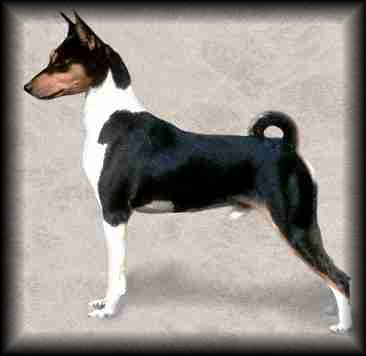
The Basenji, popularly known as the "barkless dog," is one of the oldest breeds. The first specimens were brought from the source of the Nile as presents to the Pharaohs of ancient Egypt. Later, when the civilization of Egypt declined and fell, the Basenji lapsed into obscurity. However, it was still valued and preserved in its native land of Central Africa, where it was highly prized for its intelligence, speed, hunting power, and silence.
Centuries later an English explorer rediscovered the Basenji and a pair were brought to England in 1895. Unfortunately, these little dogs contracted distemper and shortly thereafter died. Aside from that abortive attempt to make the breed known, the "outside" world in general did not hear of the Basenji until 1937, when it was successfully introduced to England. At the same time, a pair were brought to America by Mrs. Byron Rogers of New York City. Unfortunately for America, this pair and a litter of puppies produced from mating these specimens contracted distemper. All died except the older male dog, Bois.
In 1941 a young female Basenji was brought from Africa to Boston; Alexander Phemister of Kingston, Mass., obtained her and shortly afterward also acquired the male dog, Bois, that Mrs. Rogers had brought into the country in 1937. The young female, Congo, and Bois, both African-bred, were mated, resulting in the first litter of Basenji puppies to be raised to maturity in America. Later other Basenjis were imported from the Canadian kennels of Dr. A. R. B. Richmond, and still others were brought over from England.
Dog lovers all over the country became interested in this breed--so old, yet so new in America--and later purchased young specimens as foundation breeding stock. In 1942 the Basenji Club of America was formed and accepted the breed standard as drawn up by the Basenji Club of England. In 1943, the American Kennel Club accepted the breed for registration in the Stud Book, and approved the standard. Within a few months, there were 59 Basenjis registered.
The Basenji is about the size and build of a Fox Terrier. The first impression one gets of a Basenji is that he is a proud little dog, and then one is impressed with his beauty, grace, and intelligence. In fact, he has often been compared to a little deer.
The coat of the Basenji is one of his most beautiful features. Coming from a tropical climate, the mixture is silky and shines like burnished copper in the sun. In colder countries the coat tends to become more coarse, but it never loses its brilliant luster. Other distinctive features include: the lack of bark; the forehead deeply furrowed with wrinkles; the prick ears, standing straight up from their heads; and the dark, intelligent, far-seeing eyes.
The Basenji's intelligence and courage stands proven by his use in his native habitat. The natives use him for pointing, retrieving, for driving game into nets, and for hunting wounded quarry. He is also used for hunting the reed rats--vicious long-toothed creatures weighing from 12 to 20 pounds--and here his silence is a particularly valuable asset.
Those in America and England who have had the opportunity to know the little Basenji have found him to be all they could hope for in a dog. He is a fascinating, endearing fellow, full of play, yet gentle as a kitten. His fastidious, dainty habits, such as cleaning himself all over as does a cat, make him an ideal dog for the immaculate housekeeper.
The Basenji's distinctive sound of happiness fairly thrills one, yet it's a sound hard to describe. It is somewhere between a chortle and a yodel. However, he is usually very happy when he makes it and one can't help but share the happiness with him.
He is, by nature, an obedient dog--tractable and anxious to please. His sprightly, alert manner in the show and obedience rings, and his beautiful gait (resembling that of a thoroughbred horse), elicits much favorable comment.