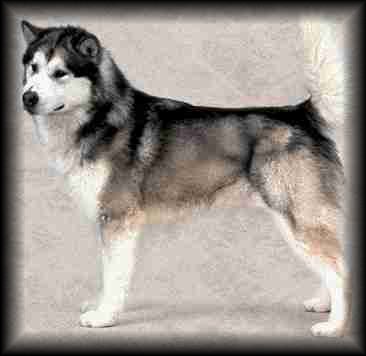
The Alaskan Malamute, one of the oldest Arctic sled dogs, was named after the native Innuit tribe called Mahlemuts, who settled along the shores of Kotzebue Sound in the upper western part of Alaska. Long before Alaska became a possession of the United States, this Arctic region was called "Alashak" or "Alyeska," (meaning "vast country") by the Russians, who were its discoverers. Native people were already living in Alyeska land when these Asiatic sailors visited the shores, having been forced by storms when whaling in Bering Strait to land in this North country opposite Siberia. Returned to their homeland, they told stories about seeing "native people using dogs to haul sledges."
The origin of these people and of the dogs has never been ascertained. We do know that they had been in Alaska for generations, but where they came from is as indefinite as it is with any of the other Arctic natives.
Well-informed Arctic writers who have made a study of Arctic formations seem to disagree about the origin of the Arctic peoples. Some believe that during the Glacier Age there was land connecting Asia and Alaska, and also Greenland and Labrador. Perhaps our Alaskan natives and Labrador Eskimos came into these countries by dog power. Others claim immigration spread from the Hudson Bay country, east and west; others that Greenland was originated by Norwegians who went "native" and likewise, Alaska by Asiatic people. This happened many generations ago--all we know today is that Arctic breeds were found and that the Alaskan Arctic sledge dog native to that country is the breed now called the Malamute.
The tribe of Mahlemuts, now spelled Malamutes, were called "high-type" Innuits. Translations from Russian explorers and records left by Englishmen who traveled the Alaskan coast, give agreeing accounts of these fine Innuits. Innuit means "people" in the Orarian language. Never are the Mahlemuts mentioned without reference to their dogs. One writer, who went to Alaska in the early days of exploration after it had become a possession of the United States, reported:
. . . Upon arriving at Unalakleet, I found that a part of Mahlemuts had arrived the day before by dog teams. They had carried mail from Point Barrow down along the coast wherever White Men were living. They had also been runners for the Russian Muscovy Whaling Company when they had landed in this Arctic region. These Mahlemuts were wonderful looking natives . . . taller than their Greenland cousins. They were industrious, skilled in hunting and fishing, made perfect sledges, and had dogs of . . . beauty and endurance. These dogs had traveled . . . hundreds of miles and being better cared for by their drivers than is the usual lot of Arctic dogs . . . [they] were affectionate and seemed tireless . . .
This description differs from tales told by people who have seen other native dogs in the Arctic, whose dispositions perhaps resulted from the environment in which they lived. The usual treatment of sledge dogs in the North has been harsh, owing to the uncivilized tribes who wandered from place to place until white men invaded their villages.
Another Alaskan traveler, a missionary who journeyed thousands of miles by dog team, writes:
. . . These Malamutes, now spelled Malamute, a corruption of the original word Mahlemut (Mahle meaning name of the Innuit tribe and Mut meaning Village in the Orarian vocabulary of the Mahlemut dialect), are a high-type people. They are peaceful, happy, hard workers, believe in one wife, are able guides and have wonderful dogs. Even though uncivilized, they have realized that it is important to have fine animals to pull sledges; that without them, means of travel in this sort of country would be impossible at times. The dogs are powerful looking, have thick dense double coats (outer coat of thick coarse fur and inner coat of fuzzy down lying close to skin) called weather coats, erect ears, magnificently bushy tails carried over their backs like waving plumes, tough feet, colors varying but mostly wolf grey or black and white. The dogs have remarkable endurance and fortitude. The Malamute people and their dogs are much respected among other Innuits. . . .
A Russian translation gives another reference about the "Mahlemuts found over the sea in the Vast Land" called the "stopping-off" place by the Russian sailors. This writer referred to the workmanship of the Mahlemuts and the sledges, and admitted the "Mahlemut dogs and sledges are better than those of the Russians for interior travel."
It is confirmed that these Alaskan Malamute sledge dogs were used as draught animals and they have never lost their identity. When Alaska became settled by white men, it is true that the Arctic breed was mingled with that of outside dogs, just as they had been in Greenland, Labrador, Siberia, and the other Arctic countries. During the Alaskan Sweepstakes, the lure of racing became so popular that many drivers tried all sorts of experiments in mixing the Arctic breed with some outside strain, and this period from 1909 to 1918 was the age of "decay of the Arctic sledge dog." Fortunately, the sport of sled-dog racing became popular in the United States, and interest in developing the pure strain of the native Alaskan Malamute started in 1926 after a careful study of all types of Northern breeds had been made. Malamutes still hold many racing records.
The Alaskan Malamute is the native Alaskan Arctic breed, cousin to the Samoyed of Russia, Siberian Husky (Kolyma River Region), and the Eskimo dogs of Greenland and Labrador.
The Alaskan Malamute was recognized for AKC registration in 1935. As pets they have become popular sled dogs among sportspeople who enjoy this winter recreation. They are very fond of people and especially children, who enjoy driving them to sleds.