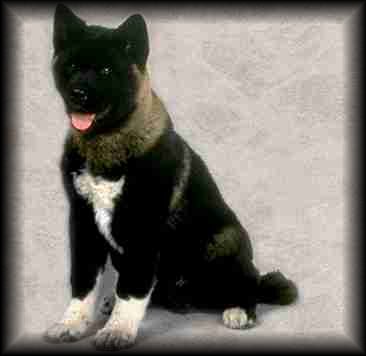
The Akita is one of seven breeds designated as a national monument in his native country of Japan. Bred as a versatile hunting dog in the rugged mountains of Northern Japan, the breed is a wonderful combination of dignity with good nature, alert courage and docility.
There is a spiritual significance attached to the Akita. In Japan they are affectionately regarded as loyal companions and pets, protectors of the home and a symbol of good health. When a child is born, the proud family will usually receive a small statue of an Akita signifying health, happiness and a long life. If a person is ill, friends will send a small statue of an Akita to express their wish for a speedy recovery.
The Akita is very affectionate with family members and friends and thrives on human companionship. Since times long past, Japanese mothers have left their children in the trusted care of the family Akita. Typically reserved in demeanor, he will stand to the defense of his family whenever a threatening stranger or animal arouses his protective instinct.
The Akita today is the modern-day, large-sized descendant of the ancient Japanese dog whose likeness has been found carved in the tombs of the early Japanese people. The upright ears and tail curled over the back are unmistakable.
Historical records cite the breed's development early in the 17th century. A famous nobleman was exiled to Akita Prefecture, the northernmost province of the island of Honshu, Japan, and ordered to live out his days as a provincial ruler. The nobleman had an ardent interest in dogs and encouraged the land barons in his domain to compete in the breeding of a large, versatile, intelligent hunting dog. Through generations of selective breeding there evolved the Akita, of superior size and frame, with keen hunting abilities, powerful working attributes and a fearless spirit.
An ancient Japanese word, matagi, means esteemed hunter, an honor that is applied to the men of a village having the best hunting skills. The northern Akita is a rugged mountainous area with cold snowy winters. There the Akita was known as Matagiinu, esteemed dog hunter, and used to hunt bear, deer and wild boar. The Yezo, largest and fiercest of old world bears, was held at bay by a team of Akitas, a male and a female, awaiting the arrival of the hunter with arrow or spear.
The Akita's hunting abilities include great strength, keen eye and nose, silence and speed in a resoundingly durable, sturdy body, suitable for hunting in deep snows. His hard, intelligent, never-give-in attitude in the field was prized by his masters. His soft mouth enabled him to retrieve waterfowl after they had been brought down by the hunter's arrow. The breed is said to have been used to drive fish at sea into the fisherman's nets.
Once ownership was restricted to the Imperial family and the ruling aristocracy. Care and feeding of the Akita were detailed in elaborate ceremony and special leashes were used to denote the Akita's rank and the standing of his owner. A special vocabulary was used to address the Akita and in speaking about them. Each Akita became the charge of a specially appointed caretaker who wore an ornate costume commensurate with the esteem in which the individual Akita was held.
Several times during the next 300 years the breed suffered near extinction, as interest in the continuity of selective breeding surged and waned, depending on the inclination of the current ruling class. Fortunately periodic favor managed to perpetuate the breed through the Meiji and Taisho eras. As the 20th century drew near and Japan was exposed to other societies, being a dog-devotee became very fashionable in emulation of the European culture.
In 1927, the Akitainu Hozankai society of Japan was established to preserve the purity of the breed. In July 1931, the government of Japan designated the Akita breed as a national monument and as one of Japan's national treasures. So highly regarded is the breed that the Japanese government will subsidize the care and feeding of an Akita champion if the owner is unable to do so.
Each year at a solemn ceremony in Tokyo's Shibuya railroad station hundreds of dog lovers do homage to the loyalty and devotion of an Akita dog, Hachiko, faithful pet of Dr. Eisaburo Ueno, a professor at Tokyo University.
It was the daily habit of Hachiko to accompany his master to the train station to see him off. Every afternoon Hachiko would return to the station to greet his master. On a May evening in 1925, Professor Ueno did not return; he had died that afternoon at the university. Hachiko, the loyal Akita, waited at the station until midnight. The next day and for the next nine years Hachiko returned to the station and waited for his beloved master before walking home, alone. Nothing and no one could discourage Hachiko from maintaining his nightly vigil. It was not until he followed his master in death, in March 1934, that Hachiko failed to appear in his place at the railroad station.
The fidelity of Hachiko was known throughout Japan. Upon his death, newspaper stories led to the suggestion that a statue be erected in the station. Contributions from the United States and other countries were received. Today the statue of the Akita, Hachiko, pays silent tribute to the breed's faithfulness and loyalty.
The renowned Helen Keller is credited with bringing the first Akitas into the United States. While visiting the Prefecture of Akita in June 1937, she was presented with a two month old puppy by the Ministry of Education. Later, after the death of the puppy, the Ministry forwarded a second Akita to Miss Keller.
The breed's popularity in the United States following World War II may be attributed to American servicemen of the occupational forces, who so admired the noble dogs that they took them home to their families. They were attracted to the Akita because of the breed's intelligence ] and adaptability to different situations.
The Akita Club of America was founded in 1956. The breed was admitted to registration in the American Kennel Club Stud Book in October, 1972, and to regular show classification in the Working Group at AKC shows beginning April 4, 1973.